October, 2026 Newsletter
Dear Mitigate ESG Platform users,
We are excited to share the latest updates and enhancements to the Mitigate ESG platform! Our continuous development aims to make your reporting experience even more efficient and user-friendly.
Please take a look at the news below, categorized into three sections:
- New features
- Other improvements
- 🚀 Coming soon!
New features
VSME reporting updated to the Voluntary Standard
VSME reporting on the platform now follows the Voluntary Standard - Commission Delegated Regulation (EU) 2026/1560, which replaces Commission Recommendation (EU) 2025/1710. Data you entered earlier is kept. Data points that are no longer part of the standard are not shown in reports, and new data points are available in all reporting years.
Changes by disclosure requirement
Basic Module
-
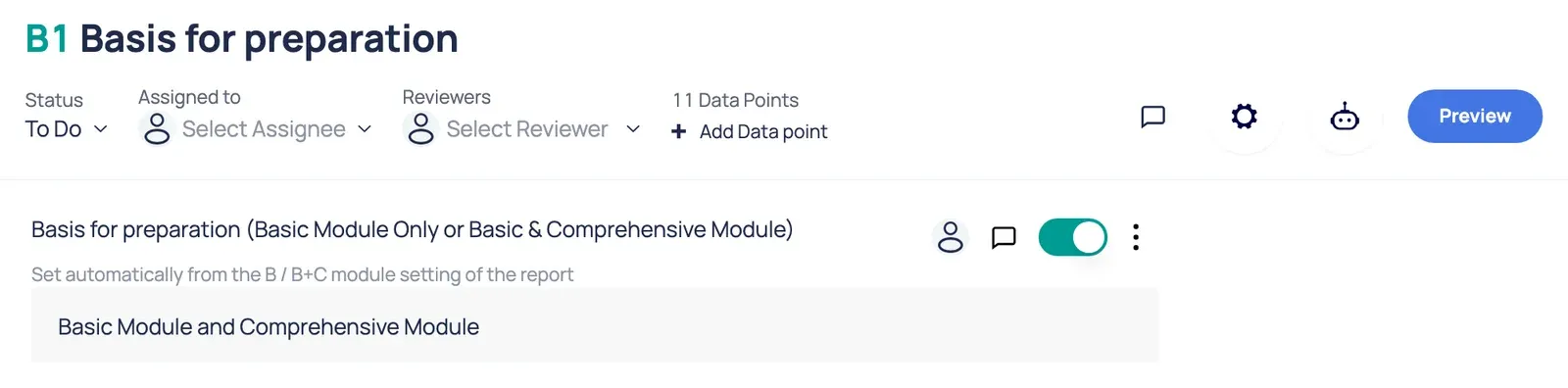
B1 – Basis for preparation: new data point “Basis for preparation (Basic Module Only or Basic & Comprehensive Module)”. It is filled in automatically from the B / B+C module setting of your report and cannot be edited. The omitted-disclosures data point is renamed to “Indicate the disclosures that the undertaking has omitted”.
-
B2 – Practices, policies and future initiatives for transitioning towards a more sustainable economy: no changes.
-
B3 – Energy and greenhouse gas emissions: GHG intensity is removed.
-
B4 – Pollution of air, water and soil: no changes.
-
B5 – Biodiversity: the area of sites in or near biodiversity-sensitive areas and the land-use table are removed. New data point: “Sites or locations in or near a biodiversity-sensitive area (BSA) and the name of the BSA”.
-
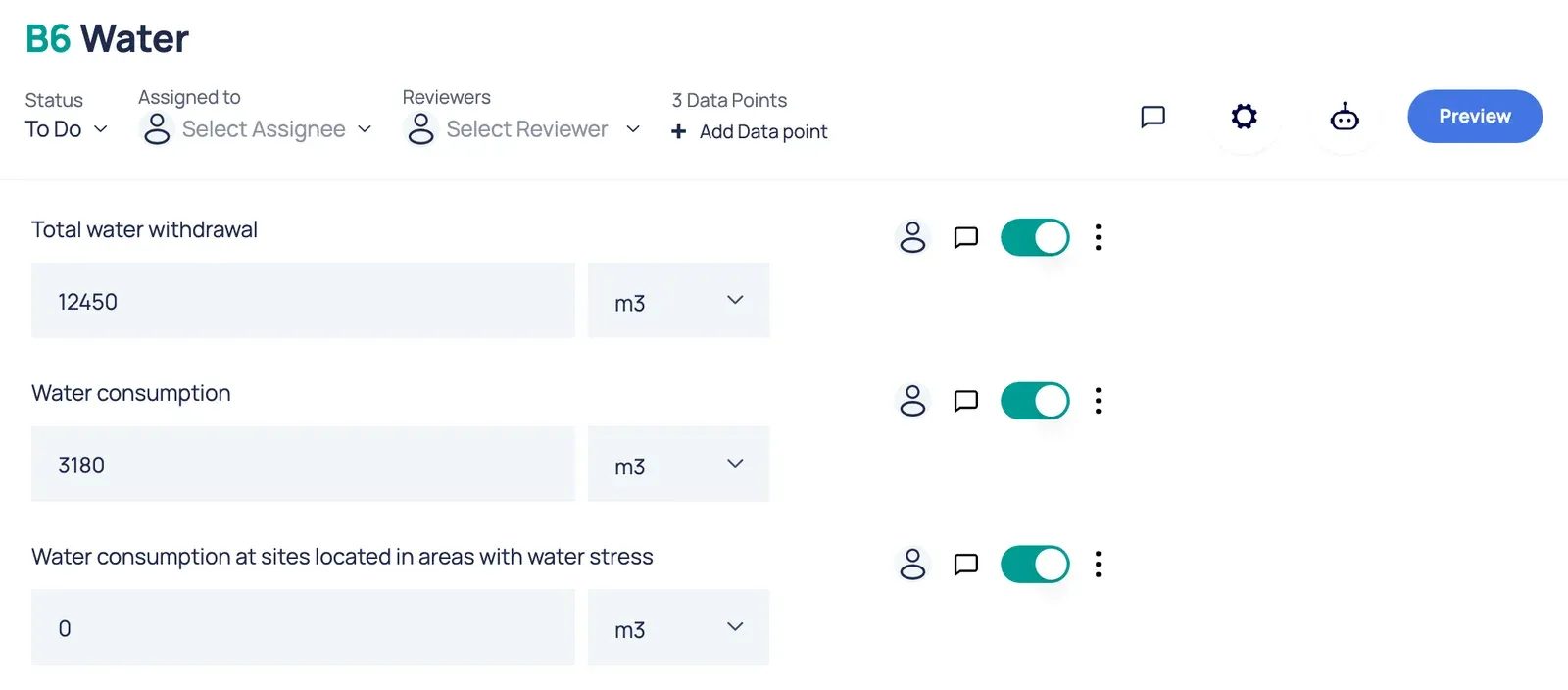
B6 – Water: the water table is replaced by three data points in m3: total water withdrawal, water consumption, and water consumption at sites located in areas with water stress.
-
B7 – Resource use, circular economy and waste management: the circular economy data point is renamed to “Does the undertaking apply circular economy principles and, if so, how does it apply them?”. The hazardous and non-hazardous waste tables are replaced by a “Total weight of waste generated” table (hazardous, non-hazardous, total) and a new data point “Proportion of waste diverted to recycling or preparation for reuse” (%).
-
B8 – Workforce – General characteristics: the employee turnover rate has moved to C5.
-
B9 – Workforce – Health and safety: data point names updated to the standard wording (“Number of recordable work-related accidents” and “Sum of fatalities as a result of recordable work-related accidents and recordable work-related ill health”).
-
B10 – Workforce – Remuneration, collective bargaining and training: the gender pay gap is to be reported only if the undertaking is already required to report it by EU law or other national regulations. Training hours by gender are replaced by “Average number of annual training hours per employee”.
-
B11 – Convictions and fines for corruption and bribery: no changes.
Comprehensive Module
- C1 – Strategy: Business Model and Sustainability – Related Initiatives: “Description of main business relationships” updated to the standard wording.
- C2 – Description of practices, policies and future initiatives for transitioning towards a more sustainable economy: no changes.
- C3 – GHG reduction targets and climate transition: no changes.
- C4 – Climate risks: the description of climate-related hazards and transition events and their time horizons are now two separate data points.
- C5 – Additional (general) workforce characteristics: new data point “Employee turnover rate for the reporting period” (previously in B8). The 50-employee threshold is removed from the female-to-male ratio and from self-employed and temporary workers.
- C6 – Additional own workforce information – Human rights policies and processes: no changes.
- C7 – Human rights incidents: new title (previously “Severe negative human rights incidents”). The value chain question now refers to incidents “identified in the reporting period”.
- C8 – Revenues from certain activities: new title (previously “Revenues from certain sectors and exclusion from EU reference benchmarks”). “Controversial weapons” is now “Prohibited weapons industry”, chemicals production now covers all activities under NACE Division 20.2, and the exclusion from EU Paris-aligned benchmarks is removed.
- C9 – Gender diversity ratio in the governance body: no changes.
What should you check?
- Open your 2026 VSME report and fill in the new data points (B5, B6, B7, B10, C4, C5).
- If you reported GHG intensity, land use, the previous water or waste tables, or training hours by gender, these values are kept. They are still visible in the form, marked as deprecated, but are no longer shown in the report.
Deprecated VSME data points
Data points that are no longer part of the Voluntary Standard (GHG intensity, area of sites and land use in biodiversity-sensitive areas, the previous water and waste tables, employee turnover rate under B8, training hours by gender and exclusion from EU Paris-aligned benchmarks) are now marked as Deprecated. A yellow warning icon is shown next to them - hover over it to see the deprecation date and the reason. To keep your historical records intact, these data points and their values remain available in your existing reports.
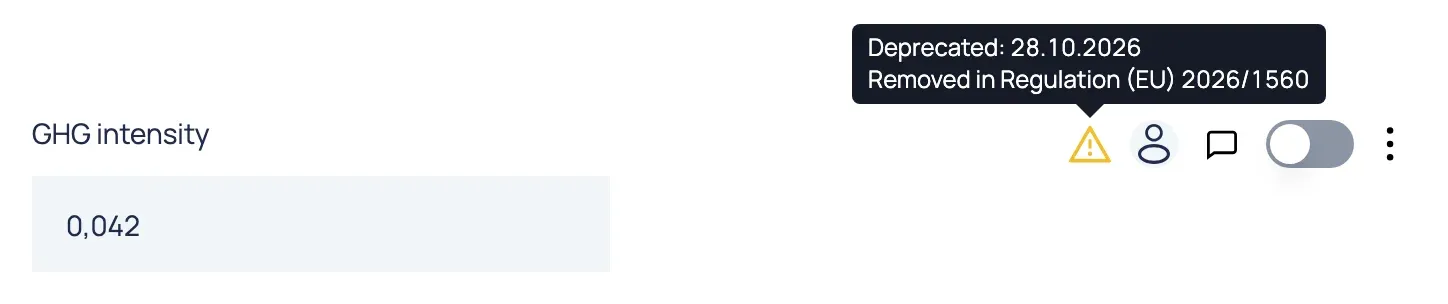
- Not shown in reports by default: the “Show in generated reports” switch is off for deprecated data points. If you want to keep one in your report, you can switch it on.
- Deleting: you can delete a deprecated data point you no longer need via the ⋮ menu → Delete data point.
- New data points are added to the relevant disclosure requirements. To change the order of data points, see Reordering data points.
- Creating a new reporting year: deprecated data points are not included.
- Cloning data from the previous year: deprecated data points are copied together with their values and stay hidden from the report. They will be copied again with every future cloning until you delete them.
VSME pages in the Knowledge Base updated
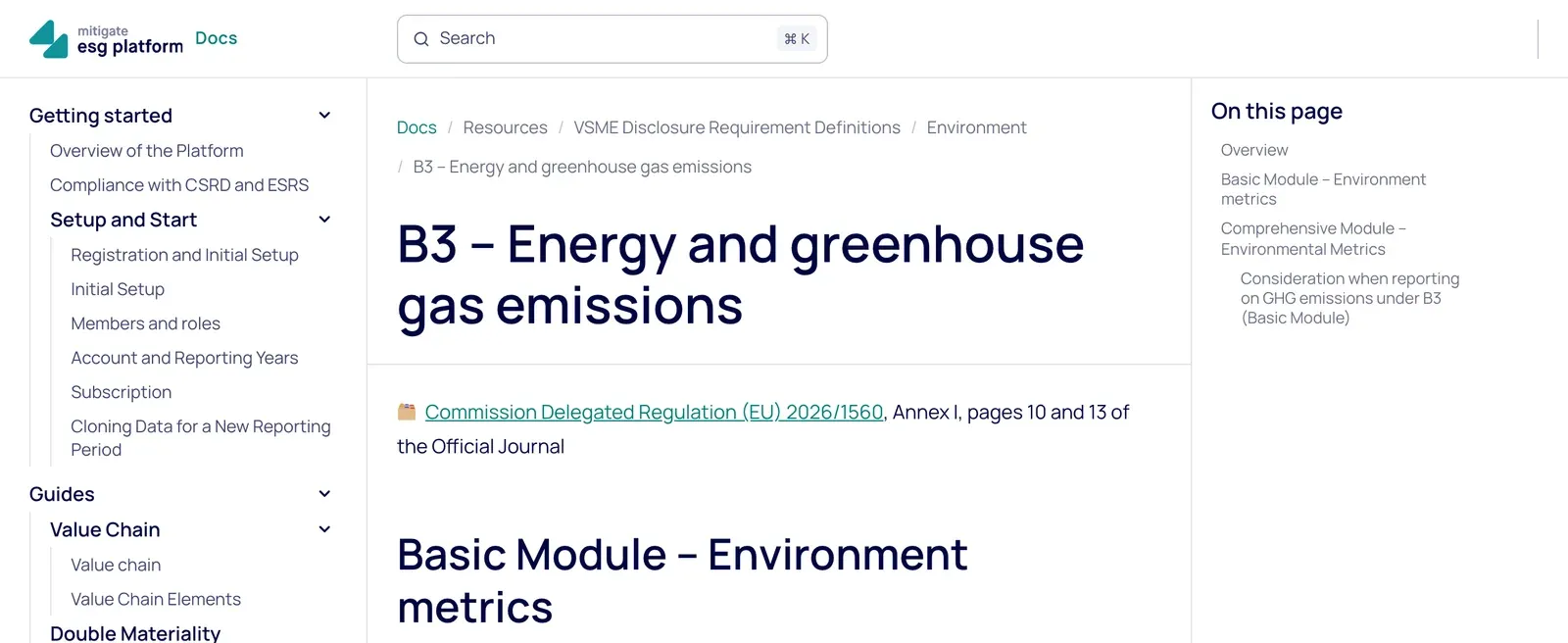
The VSME pages in our Knowledge Base now contain the text of the Voluntary Standard, with the official paragraph numbering.
Additional guidance on the Voluntary Standard is available on EFRAG’s Knowledge Hub.
Help & updates panel on the home page
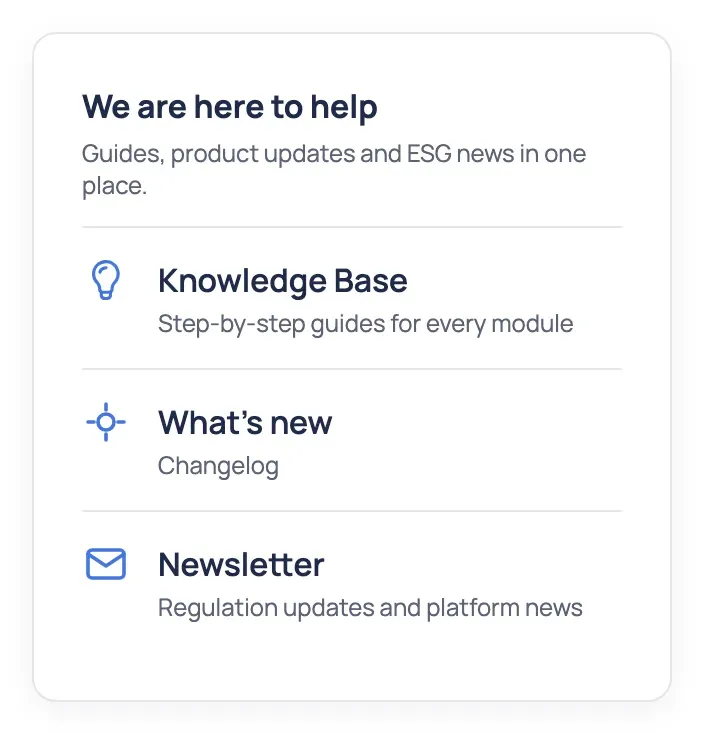
A new help panel “We are here to help” on the home page gives you quick access to the Knowledge Base, the Changelog and the Newsletter.
Other improvements
- Long option names in dropdown menus are now fully visible, with the full text also shown on hover.
- Cloning a reporting year now also copies the background images of Custom pages.
- AI-generated Data Point answers are now written directly in your company’s language.
- The Translations section now opens on the General Disclosures tab by default.
- Technical improvements and platform updates for better security, stability and performance.
🚀 Coming soon!
Simplified ESRS (2026/2027)
We are actively working on implementing the simplified (revised) ESRS - Commission Delegated Regulation (EU) 2026/1563 - on the platform. The simplified ESRS are mandatory for financial years beginning on or after 1 January 2027 and can already be applied for the 2026 financial year. We will keep you informed as the changes become available.
If you have any questions, please contact us at esg@mitigate.dev!
Thank you for being a part of the Mitigate ESG journey. We value your feedback and look forward to continuing to enhance your experience.
Best regards,
The ESG Mitigate Team