AI Data Analysis
We developed the AI Data Analysis feature to help you extract tailored recommendations from your documents for each ESRS data point. This feature can save you significant time, especially when you’re working with multiple documents containing company or sustainability-related information that must be disclosed according to ESRS.
To use the feature effectively, it’s important to understand two key points:
- How the feature works conceptually,
- The feature relies on Generative AI technology, which may occasionally produce inaccuracies (commonly referred to as “hallucinations”).
🙋🏼♀️ Most importantly, think of the AI Data Analysis feature as a recommendation engine, not a replacement for crafting high-quality disclosure descriptions. While it’s a powerful tool for generating suggestions, the technology isn’t advanced enough to fully replace the expertise and judgment needed for accurate, top-notch disclosures… yet! 😉
How it works
Section titled “How it works”You have full control over when to run the feature. Each time you run it, a credit—referred to as “a run”—is used. When you purchase a credit, it adds a new run to your balance. After completing a run, one credit is deducted from your total. You can purchase multiple runs at once and use them whenever needed.
You will have 2 options:
- Demo Run
This option is available for first-time use and focuses only on the Governance sustainability topic, allowing you to test the feature. 2. Full Run
This option analyses all material sub-topics.
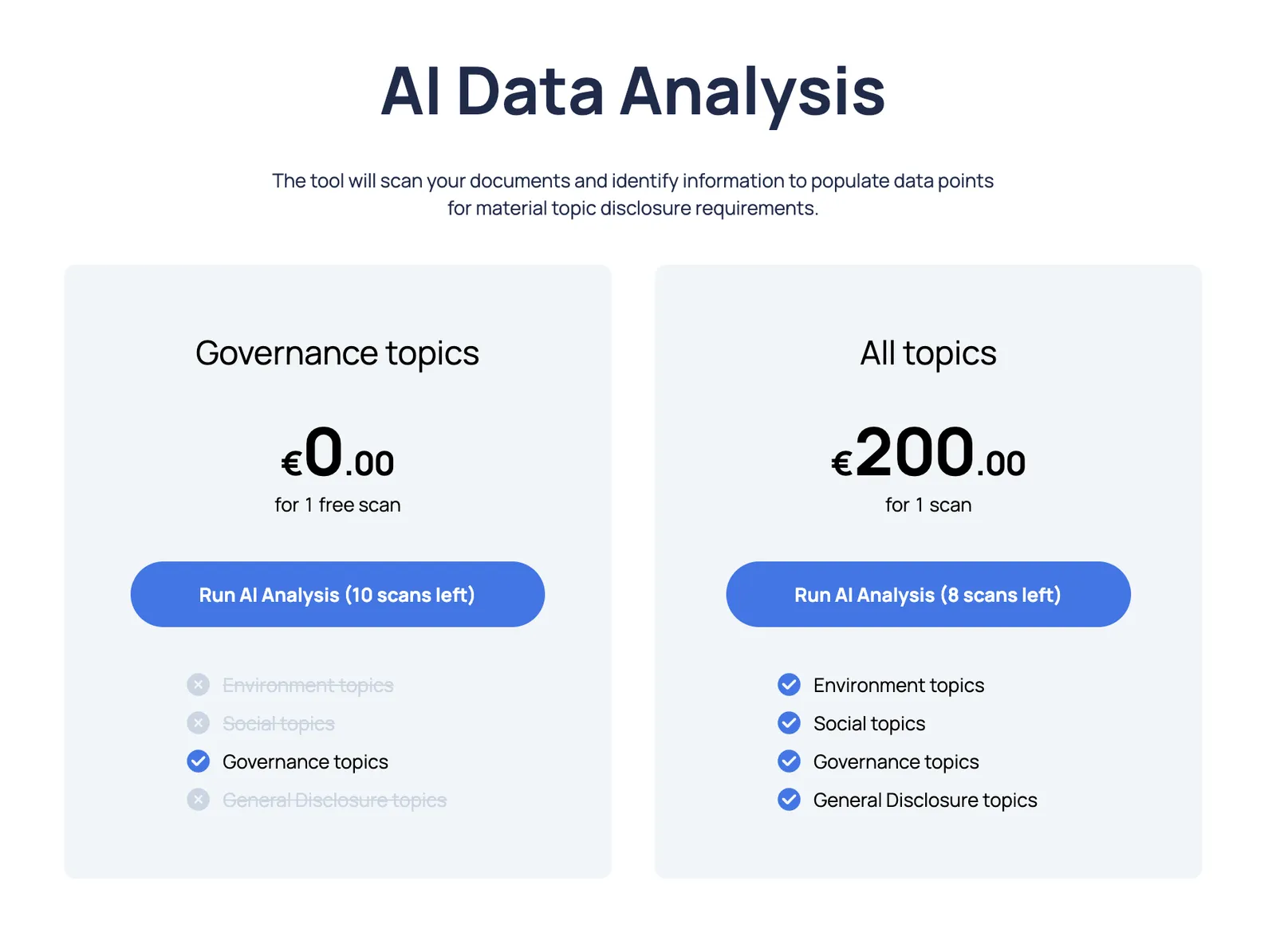
What happens when you run the feature.
It has 3 inputs:
- Your documents Uploaded under the “Documents” section. Ensure they are switched on to be included in the analysis:

- Selected material sustainability sub-topics The feature processes data points only for material sub-topics. You can select these under the “Materiality Assessments” → “Topics” section.
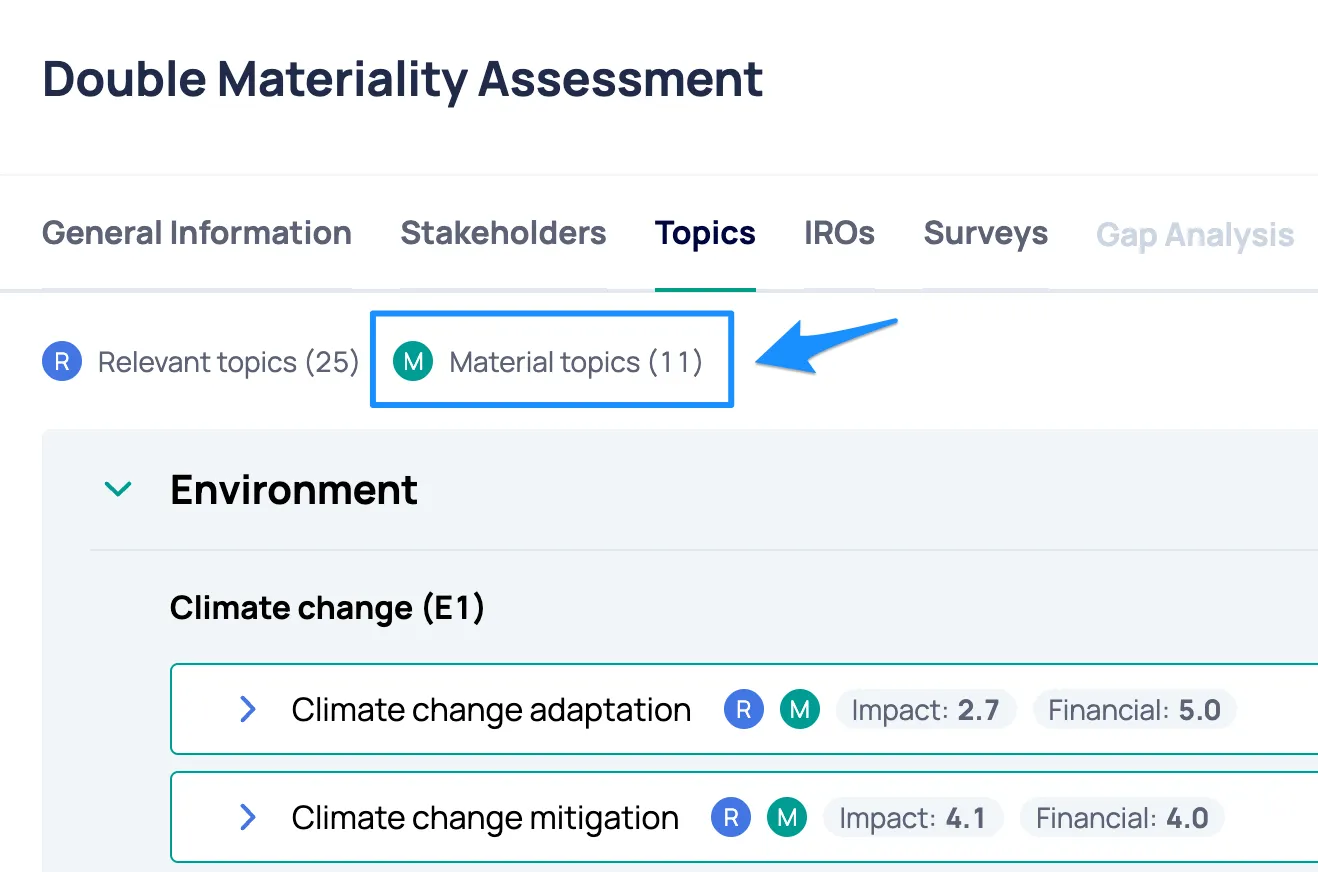
- ESRS data point requirements Data points defined within ESRS disclosure requirements guide the analysis.
The process is as follows:
- Material Data Point Selection The tool identifies data points related to the selected material sub-topics.
- Data Point Analysis (for each data point):
- Query Documents: It retrieves relevant information using semantic search technology.
- ESRS Compliance Check: It refers to the ESRS description for the specific data point.
- Generate Recommendation: It combines the relevant document information with the ESRS description to create a recommended description.
- Create Recommendations Recommendations are generated for your confirmation or refusal.
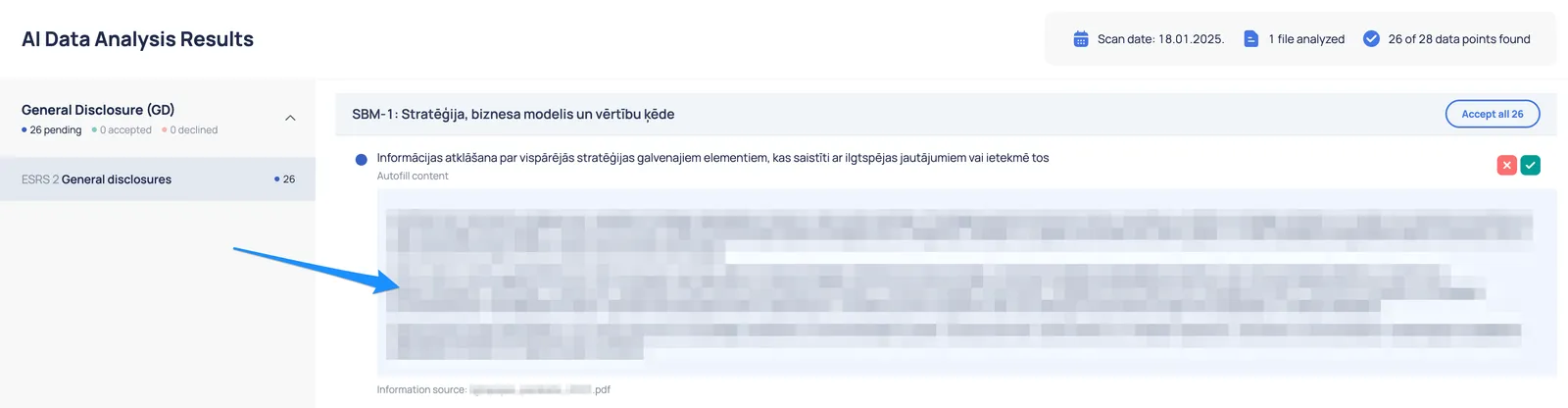
- Confirm or Decline Recommendations:
- Confirm: The recommendation is added to the corresponding data point in “ESG Reporting” → “Disclosure Requirement” → “Data Point.” You can edit it later.
- Decline: The recommendation is marked as declined, and no changes are made.
Limitations of the technology
Section titled “Limitations of the technology”The AI Data Analysis feature relies on Generative AI technology, which comes with certain limitations:
- Potential mistakes (hallucinations): Generative AI may occasionally produce outputs that are incorrect or irrelevant. These inaccuracies, often called “hallucinations,” can happen when the AI misinterprets the content of your documents or overgeneralises information.
- Reliance on document quality: The quality of the results depends on the accuracy and completeness of your uploaded documents. If the documents are outdated, incomplete, or contain errors, the AI may generate less useful recommendations. The same is true if documents have poor technical quality - includes embedded images instead of texts etc.
- Context understanding: While the AI uses advanced semantic search, it might struggle with highly nuanced or industry-specific terminology, which could affect the relevance of the recommendations.
- Manual Review Required: The generated recommendations should always be reviewed and validated by users to ensure they align with your specific reporting needs and compliance requirements.
These limitations highlight the importance of careful review and validation of AI-generated outputs to ensure accuracy and reliability in your ESG reporting.