E1-4 – Targets related to climate change mitigation and adaptation
🗂️ ESRS E1 Climate Change, page 7-8
-
The undertaking shall disclose the climate-related targets it has set.
-
The objective of this Disclosure Requirement is to enable an understanding of the targets the undertaking has set to support its climate change mitigation and adaptation policies and address its material climate-related impacts, risks and opportunities.
-
The disclosure of the targets required in paragraph 30 shall contain the information required in ESRS 2 MDR-T Tracking effectiveness of policies and actions through targets.
-
For the disclosure required by paragraph 30, the undertaking shall disclose whether and how it has set GHG emissions reduction targets and/or any other targets to manage material climate-related impacts, risks and opportunities, for example, renewable energy deployment, energy efficiency, climate change adaptation, and physical or transition risk mitigation.
-
If the undertaking has set GHG emission reduction targets, ESRS 2 MDR-T and the following requirements shall apply:
(a) GHG emission reduction targets shall be disclosed in absolute value (either in tonnes of CO2eq or as a percentage of the emissions of a base year) and, where relevant, in intensity value;
(b) GHG emission reduction targets shall be disclosed for Scope 1, 2, and 3 GHG emissions, either separately or combined. The undertaking shall specify, in case of combined GHG emission reduction targets, which GHG emission Scopes (1, 2 and/or 3) are covered by the target, the share related to each respective GHG emission Scope and which GHGs are covered. The undertaking shall explain how the consistency of these targets with its GHG inventory boundaries is ensured (as required by Disclosure Requirement E1-6). The GHG emission reduction targets shall be gross targets, meaning that the undertaking shall not include GHG removals, carbon credits or avoided emissions as a means of achieving the GHG emission reduction targets;
(c) the undertaking shall disclose its current base year and baseline value, and from 2030 onwards, update the base year for its GHG emission reduction targets after every fiveyear period thereafter. The undertaking may disclose the past progress made in meeting its targets before its current base year provided that this information is consistent with the requirements of this Standard;
(d) GHG emission reduction targets shall at least include target values for the year 2030 and, if available, for the year 2050. From 2030, target values shall be set after every 5year period thereafter;
(e) the undertaking shall state whether the GHG emission reduction targets are science- based and compatible with limiting global warming to 1.5°C. The undertaking shall state which framework and methodology has been used to determine these targets including whether they are derived using a sectoral decarbonisation pathway and what the underlying climate and policy scenarios are and whether the targets have been externally assured. As part of the critical assumptions for setting GHG emission reduction targets, the undertaking shall briefly explain how it has considered future developments (e.g., changes in sales volumes, shifts in customer preferences and demand, regulatory factors, and new technologies) and how these will potentially impact both its GHG emissions and emissions reductions; and
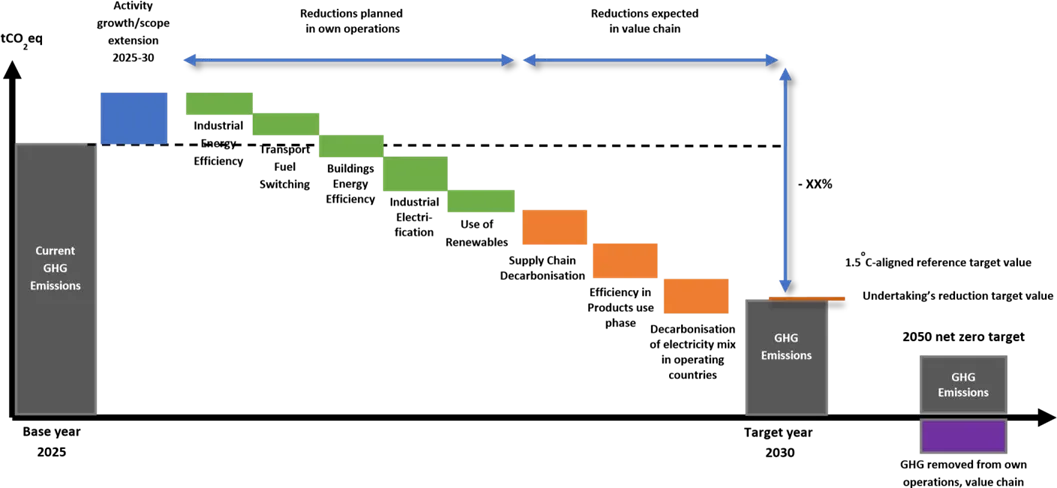
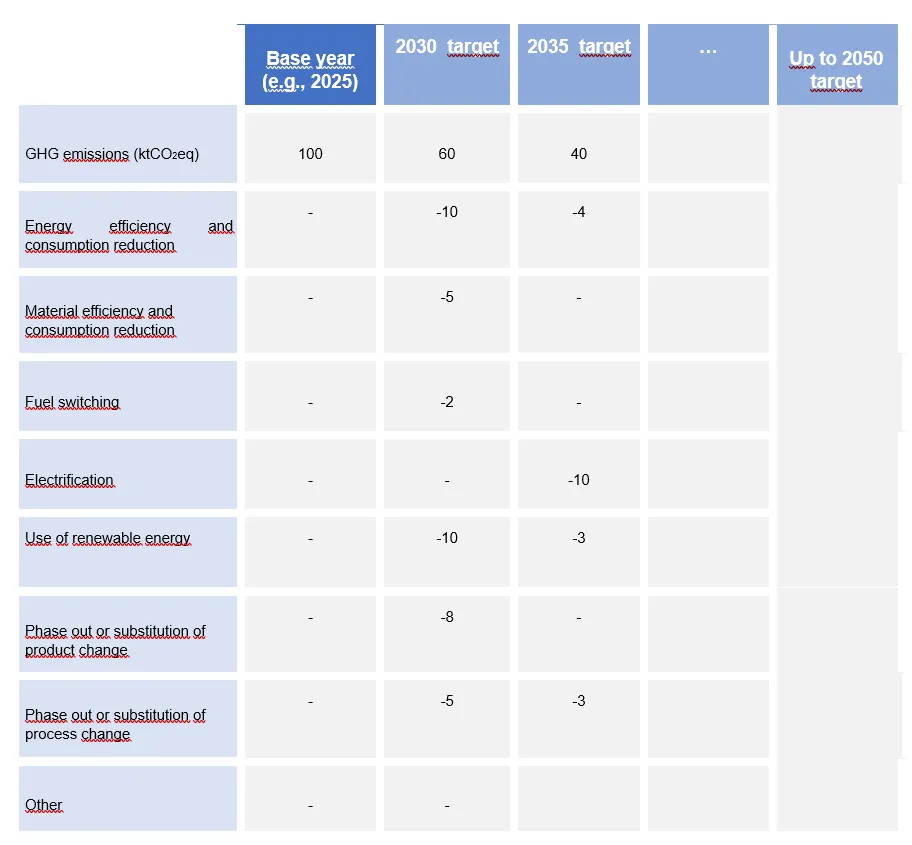
(f) the undertaking shall describe the expected decarbonisation levers and their overall quantitative contributions to achieve the GHG emission reduction targets (e.g., energy or material efficiency and consumption reduction, fuel switching, use of renewable energy, phase out or substitution of product and process).
Application Requirements
Section titled “Application Requirements”AR 23. Under paragraph 34 (a), the undertaking may disclose GHG emission reduction targets in intensity value. Intensity targets are formulated as ratios of GHG emissions relative to a unit of physical activity or economic output. Relevant units of activity or output are referred to in ESRS sector-specific standards. In cases where the undertaking has only set a GHG intensity reduction target, it shall nevertheless disclose the associated absolute values for the target year and interim target year(s). This may result in a situation where an undertaking is required to disclose an increase of absolute GHG emissions for the target year and interim target year(s), for example because it anticipates organic growth of its business.
AR 24. When disclosing the information required under paragraph 34 (b), the undertaking shall specify the share of the target related to each respective GHG emission Scope (1, 2 or 3). The undertaking shall state the method used to calculate Scope 2 GHG emissions included in the target (i.e., either the location-based or market-based method). If the boundary of the GHG emission reduction target diverges from that of the GHG emissions reported under Disclosure Requirement E1-6, the undertaking shall disclose which gases are covered, the respective percentage of Scope 1, 2, 3 and total GHG emissions covered by the target. For the GHG emission reduction targets of its subsidiaries, the undertaking shall analogously apply these requirements at the level of the subsidiary.
AR 25. When disclosing the information required under paragraph 34(c) on base year and baseline value:
(a) the undertaking shall briefly explain how it has ensured that the baseline value against which the progress towards the target is measured is representative in terms of the activities covered and the influences from external factors (e.g., temperature anomalies in a certain year influencing the amount of energy consumption and related GHG emissions). This can be done by the normalisation of the baseline value, or, by using a baseline value that is derived from a 3-year average if this increases the representativeness and allows a more faithful representation;
(b) the baseline value and base year shall not be changed unless significant changes in either the target or reporting boundary occur. In such a case, the undertaking shall explain how the new baseline value affects the new target, its achievement and presentation of progress over time. To foster comparability, when setting new targets, the undertaking shall select a recent base year that does not precede the first reporting year of the new target period by longer than 3 years. For example, for 2030 as the target year and a target period between 2025 and 2030, the base year shall be selected from the period between 2022 and 2025;
(c) the undertaking shall update its base year from 2030 and after every 5-year period thereafter. This means that before 2030, the base years chosen by undertakings’ may be either the currently applied base year for existing targets or the first year of application of the sustainability reporting requirements as set out in Article 5(2) of Directive (EU) 2022/2464 (2024, 2025 or 2026) and, after 2030, every 5 years (2030, 2035, etc); and
(d) when presenting climate-related targets, the undertaking may disclose the progress in meeting these targets made before its current base year. In doing so, the undertaking shall, to the greatest extent possible, ensure that the information on past progress is consistent with the requirements of this Standard. In the case of methodological differences, for example, regarding target boundaries, the undertaking shall provide a brief explanation for these differences.
AR 26. When disclosing the information required under paragraphs 34 (d) and 34 (e), the undertaking shall present the information over the target period with reference to a sector- specific, if available, or a cross-sector emission pathway compatible with limiting global warming to 1.5°C. For this purpose, the undertaking shall calculate a 1.5°C aligned reference target value for Scope 1 and 2 (and, if applicable, a separate one for Scope 3) against which its own GHG emission reduction targets or interim targets in the respective Scopes can be compared.
AR 27. The reference target value may be calculated by multiplying the GHG emissions in the base year with either a sector-specific (sectoral decarbonisation methodology) or cross-sector (contraction methodology) emission reduction factor. These emission reduction factors can be derived from different sources. The undertaking should ensure that the source used is based on an emission reduction pathway compatible with limiting global warming to 1.5°C.
AR 28. The emission reduction factors are subject to further development. Consequently, undertakings are encouraged to only use updated publicly available information.

AR 29. The reference target value is dependent on the base year and baseline emissions of the undertaking’s GHG emission reduction target. As a result, the reference target value for undertakings with a recent base year or from higher baseline emissions may be less challenging to achieve than it will be for undertakings that have already taken ambitious past actions to reduce GHG emissions. Therefore, undertakings that have in the past achieved GHG emissions reductions compatible with either a 1.5°C-aligned cross-sector or sector specific pathway, may adjust their baseline emissions accordingly to determine the reference target value. Accordingly, if the undertaking is adjusting the baseline emissions to determine the reference target value, it shall not consider GHG emission reductions that precede the year 2020 and it shall provide appropriate evidence of its past achieved GHG emission reduction.
AR 30. When disclosing the information required under paragraph 34 (f), the undertaking shall explain:
(a) by reference to its climate change mitigation actions, the decarbonisation levers and their estimated quantitative contributions to the achievement of its GHG emission reduction targets broken down by each Scope (1, 2 and 3);
(b) whether it plans to adopt new technologies and the role of these to achieve its GHG emission reduction targets; and
(c) whether and how it has considered a diverse range of climate scenarios, at least including a climate scenario compatible with limiting global warming to 1.5°C, to detect relevant environmental-, societal-, technology-, market- and policy-related developments and determine its decarbonisation levers.
AR 31. The undertaking may present its GHG emission reduction targets together with its climate change mitigationactions (see paragraph AR 19) as a table or graphical pathway showing developments over time. The following figure and table provide examples combining targets and decarbonisation levers: