E1-9 – Anticipated financial effects from material physical and transition risks and potential climate-related opportunities
🗂️ ESRS E1 Climate Change, page 13-15
- The undertaking shall disclose its:
(a) anticipated financial effects from material physical risks;
(b) anticipated financial effects from material transition risks; and
(c) potential to benefit from material climate-related opportunities.
- The information required by paragraph 64 is in addition to the information on current financial effects required under ESRS 2 SeM-3 para 48 (d). The objective of this Disclosure Requirement related to:
(a) anticipated financial effects due to material physical risks and transition risks is to provide an understanding of how these risks have (or could reasonably be expected to have) a material influence on the undertaking’s financial position, financial performance and cash flows, over the short-, medium- and long- term. The results of scenario analysis used to conduct resilience analysis as required under paragraphs AR 10 to AR 13 should inform the assessment of anticipated financial effects from material physical and transition risks.
(b) potential to pursue material climate-related opportunities is to enable an understanding of how the undertaking may financially benefit from material climate- related opportunities. This disclosure is complementary to the key performance indicators to be disclosed in accordance with Commission Delegated Regulation (EU) 2021/2178.
- The disclosure of anticipated financial effects from material physical risks required by paragraph 64 (a) shall include:
(a) the monetary amount and proportion (percentage) of assets at material physical risk over the short-, medium- and long-term before considering climate change adaptation actions; with the monetary amounts of these assets disaggregated by acute and chronic physical risk;
(b) the proportion of assets at material physical risk addressed by the climate change adaptation actions;
(c) the location of significant assets at material physical risk; and
(d) the monetary amount and proportion (percentage) of net revenue from its business activities at material physical risk over the short-, medium- and long-term.
- The disclosure of anticipated financial effects from material transition risks required by paragraph 64 (b) shall include:
(a) the monetary amount and proportion (percentage) of assets at material transition risk over the short-, medium- and long-term before considering climate mitigation actions;
(b) the proportion of assets at material transition risk addressed by the climate change mitigation actions;
(c) a breakdown of the carrying value of the undertaking’s real estate assets by energyefficiency classes;
(d) liabilities that may have to be recognised in financial statements over the short-, medium- and longterm; and
(e) the monetary amount and proportion (percentage) of net revenue from its business activities at material transition risk over the short-, medium- and long-term including, where relevant, the net revenue from the undertaking’s customers operating in coal, oil and gas-related activities.
- The undertaking shall disclose reconciliations to the relevant line items or notes in the financial statements of the following:
(a) significant amounts of the assets and net revenue at material physical risk (as required by paragraph 66);
(b) significant amounts of the assets, liabilities, and net revenue at material transition risk (as required by paragraph 67).
- For the disclosure of the potential to pursue climate-related opportunities required by paragraph 64 (c) the undertaking shall consider:
(a) its expected cost savings from climate change mitigation and adaptation actions; and
(b) the potential market size or expected changes to net revenue from low-carbon products and services or adaptation solutions to which the undertaking has or may have access.
- A quantification of the financial effects that arise from opportunities is not required if such a disclosure does not meet the qualitative characteristics of useful information included under ESRS 1 Appendix e Qualitative characteristics of information.
Application Requirements
Section titled “Application Requirements”AR 67. Material climate-related physical risks and transition risks may affect the undertaking’s financial position (e.g., owned assets, financially-controlled leased assets, and liabilities), performance (e.g., potential future increase/decrease in net revenue and costs due to business interruptions, increased supply prices resulting in potential margin erosions), and cash flows. The low probability, high severity and long-term time horizons of some climate- related physical risk exposures and the uncertainty arising from the transition to a sustainable economy mean that there will be associated material anticipated financial effects that are outside the scope of the requirements of applicable accounting standards.
AR 68. Currently, there is no commonly accepted methodology to assess or measure how material physical risks and transition risks may affect the undertaking’s future financial position, financial, performance and cash flows. Therefore, the disclosure of the financial effects (as required by paragraphs 64, 66 and 67) will depend on the undertaking’s internal methodology and the exercise of significant judgement in determining the inputs, and assumptions needed to quantify their anticipated financial effects.
Calculation guidance - Anticipated financial effects from material physical risks
AR 69. When disclosing the information required under paragraphs 64 (a) and 66, the undertaking shall explain whether and how:
(a) it assessed the anticipated financial effects for assets and business activities at material physical risk, including the scope of application, time horizons, calculation methodology, critical assumptions and parameters and limitations of the assessment; and
(b) the assessment of assets and business activities considered to be at material physical risk relies on or is part of the process to determine material physical risk as required under paragraphs 20 (b) and AR 11 and to determine climate scenarios as required under paragraphs 19 and AR 13 to AR 14. In particular, it shall explain how it has defined medium- and long-term time horizons and how these definitions are linked to the expected lifetime of the undertaking’s assets, strategic planning horizons and capital allocation plans.
AR 70. When preparing the information on assets at material physical risk that is required to be disclosed under paragraph 66 (a), the undertaking shall:
(a) Calculate the assets at material physical risk in terms of monetary amount and as a proportion (percentage) of total assets at the reporting date (i.e., the proportion is an estimate of the carrying value of assets at material physical risk divided by total carrying value as stated in the statement of financial position or balance sheet). The estimate of assets at material physical risk shall be derived starting from the assets recognised in the financial statements. The estimate of monetary amounts and proportion of assets at physical risk may be presented as either a single amount or range.
(b) All types of assets including finance-lease / right-of-use assets shall be considered when determining the assets at material physical risk.
(c) To contextualise this information, the undertaking shall:
i. disclose the location of its significant assets at material physical risk. Significant assets located in the EU territory shall be aggregated by NUTS codes 3 level digits (Nomenclature of Territorial Units for Statistics). For significant assets located outside EU territory, the breakdown by NUTS code will only be provided where applicable. ii. disaggregate the monetary amounts of assets at risk by acute and chronic physical risk.
(d) calculate the share of assets at material physical risk resulting from paragraph 66 (a) that is addressed by the climate change adaptation actions based on the information disclosed under Disclosure Requirement E1-3. This aims at approximating net risks.
AR 71. When preparing the information required under paragraph 64 (a) and 66 (d), the undertaking may assess and disclose the share of net revenue from business activities at physical risk.
This disclosure
(a) shall be based on the net revenue in line with the requirements in accounting standards applied for financial statements, i.e., IFRS 15 or local GAAP.
(b) may include a breakdown of the undertaking’s business activities with the corresponding details of the associated percentage of total net revenue, the risk factors (hazards, exposure and sensitivity) and, if possible, the magnitude of the anticipated financial effects in terms of margin erosion over the short-, medium- and long-term time horizons. The nature of business activities may also be disaggregated by operating segments if the undertaking has disclosed the contribution of margins by operational segments in its segment reporting in the financial statements.
Calculation guidance - Anticipated financial effects from transition risk
AR 72. When disclosing the information required under paragraphs 64 (b) and 67 (a), the undertaking shall explain whether and how:
(a) it has assessed the potential effects on future financial performance and position for assets and business activities at material transition risk, including the scope of application, calculation methodology, critical assumptions and parameters, and limitations of the assessment; and
(b) the assessment of assets and business activities considered to be at material transition risk relies on or is part of the process to determine material transition risks as described under paragraphs 20 (c) and AR 11 and to determine scenarios as required under paragraphs AR 12 to AR 13. In particular, it shall explain how it has defined medium- and long-term time horizons and how these definitions are linked to the expected lifetime of the undertaking’s assets, strategic planning horizons and capital allocation plans.
AR 73. When disclosing the information on assets at material transition risk as required under paragraphs 67 (a) and (b):
(a) the undertaking shall at the very least include an estimate of the amount of potentially stranded assets (in monetary amounts and as a proportion/percentage) from the reporting year until 2030 and from 2030 to 2050. Stranded assets are understood as the active or firmly planned key assets of the undertaking with significant locked-in GHG emissions over their operating lifetime. Firmly planned key assets are those that the undertaking will most likely deploy within the next 5 years. The amount may be expressed as a range of asset values based on different climate and policy scenarios, including a scenario aligned with limiting climate change to 1.5°C.
(b) the undertaking shall disclose a breakdown of the carrying value of its real estate assets, including rights-of-use assets, by energy efficiency classes. The energy efficiency shall be represented in terms of either the ranges of energy consumption in kWh/m² or the EPC (Energy Performance Certificate) label class. If the undertaking cannot obtain this information on a best-effort basis, it shall disclose the total carrying amount of the real estate assets for which the energy consumption is based on internal estimates.
(c) the undertaking shall calculate the proportion (percentage) of total assets (including finance lease/right-of-use assets) at material transition risk addressed by the climate change mitigation actions based on the information disclosed under Disclosure Requirement E1-3. The total assets amount is the carrying amount on the balance sheet at the reporting date.
AR 74. When disclosing the information on potential liabilities from material transition risks required under paragraph 67(d):
(a) undertakings that operate installations regulated under an emission trading scheme may include a range of potential future liabilities originating from these schemes;
(b) undertakings subject to the EU ETS, may disclose the potential future liabilities that relate to their allocation plans for the period before and until 2030. The potential liability may be estimated on the basis of:
i. the number of allowances held by the undertaking at the beginning of the reporting period;
ii. the number of allowances to be purchased in the market yearly, i.e., before and until 2030;
iii. the gap between estimated future emissions under various transition scenarios and free allocations of allowances that are known for the period until 2030, and iv. the estimated yearly cost per tonne of CO2 for which an allowance needs to be purchased;
(c) In assessing its potential future liabilities, the undertaking may consider and disclose the number of Scope 1 GHG emission allowances within regulated emission trading schemes and the cumulative number of emission allowances stored (from previous allowances) at the beginning of the reporting period;
(d) undertakings disclosing volumes of carbon credits planned to be cancelled in the near future (Disclosure Requirement E1-7) may disclose the potential future liabilities associated with those based on existing contractual agreements;
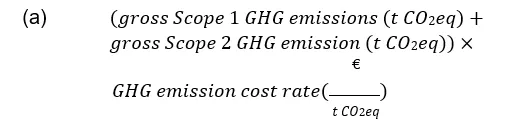
(e) the undertaking may also include its monetised gross Scope 1, 2 and total GHG emissions (in monetary units) calculated as follows:
i. monetised Scope 1 and 2 GHG emissions in the reporting year by the following formula:
ii. monetised total GHG emissions in the reporting year by the following formula:

iii. by use of a lower, middle and upper cost rate for GHG emissions (e.g., market carbon price and different estimates for the societal costs of carbon) and reasons for selecting them.
AR 75. Other approaches and methodologies may be applied to assess how transition risks may affect the future financial position of the undertaking. In any case, the disclosure of anticipated financial effects shall include a description of the methodologies and definitions used by the undertaking.
AR 76. When preparing the information required under paragraph 67 (e), the undertaking may assess and disclose the share of net revenue from business activities at transition risks. This disclosure:
(a) shall be based on the net revenue in line with the requirements in accounting standards applied for financial statements, i.e., IFRS 15 or local GAAP.
(b) may include a breakdown of the undertaking’s business activities with the corresponding details of the associated percentage of current net revenue, risk factors (events and exposure), and when possible, the anticipated financial effects related to margin erosion over the short-, medium- and long-term. The nature of business activities may also be disaggregated by operating segments if the undertaking has disclosed the contribution of margins by operational segments in its segment reporting in the financial statements.
Connectivity with financial reporting information
AR 77. The reconciliation of the significant amount of assets, liabilities, and net revenue (vulnerable to either material physical risks or transition risks) to the relevant line item or disclosure (e.g., in segment reporting) in the financial statements (as required by paragraph 68) may be presented by the undertaking as follows:
(a) as a cross-reference to the related line item or disclosure in the financial statements if these amounts are identifiable in the financial statements; or
(b) If these cannot be directly cross-referenced, as a quantitative reconciliation of each to the relevant line item or disclosure in the financial statement using the below tabular format:
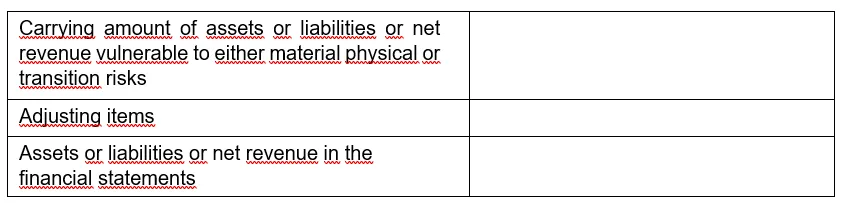
AR 78. The undertaking shall ensure the consistency of data and assumptions to assess and report the anticipated financial effects from material physical risks and transition risks in the sustainability statement with the corresponding data and assumptions used for the financial statements (e.g., carbon prices used for assessing impairment of assets, the useful life of assets, estimates and provisions). The undertaking shall explain the reasons for any inconsistencies (e.g., if the full financial implications of climate-related risks are still under assessment or are not deemed material in the financial statements).
AR 79. For potential future effects on liabilities (as required by paragraph 67 (d)), if applicable, the undertaking shall cross-reference the description of the emission trading schemes in the financial statements.
Climate-related opportunities
AR 80. When disclosing the information under paragraph 69 (a), the undertaking shall explain the nature of the cost savings (e.g., from reduced energy consumption), the time horizons and the methodology used, including the scope of the assessment, critical assumptions, and limitations, and whether and how scenario analysis was applied.
AR 81. When disclosing the information required under paragraph 69 (b), the undertaking shall explain how it has assessed the market size or any expected changes to net revenue from low-carbon products and services or adaptation solutions including the scope of the assessment, the time horizon, critical assumptions, and limitations and to what extent this market is accessible to the undertaking. The information on the market size may be put in perspective to the current taxonomy-aligned revenue disclosed under the provisions of Regulation (EU) 2020/852. The entity may also explain how it will pursue its climate-related opportunities and, where possible, this should be linked to the disclosures on policies, targets and actions under Disclosure Requirements E1-2, E1-3 and E1-4.