S1-6 – Characteristics of the Undertaking’s Employees
🗂️ ESRS S1 Own workforce, page 10
-
The undertaking shall describe key characteristics of employees in its own workforce.
-
The objective of this Disclosure Requirement is to provide insight into the undertaking’s approach to employment, including the scope and nature of impacts arising from its employment practices, to provide contextual information that aids an understanding of the information reported in other disclosures, and to serve as the basis for calculation for quantitative metrics to be disclosed under other disclosure requirements in this Standard.
-
In addition to the information required by paragraph 40(a)iii of ESRS 2 General Disclosures, the undertaking shall disclose:
(a) the total number of employees by head count, and breakdowns by gender and by country for countries in which the undertaking has 50 or more employees representing at least 10% of its total number of employees;
(b) the total number by head count or full time equivalent (FTE) of:
i. permanent employees, and breakdown by gender;
ii. temporary employees, and breakdown by gender; and
iii. non-guaranteed hours employees, and breakdown by gender.
(c) the total number of employees who have left the undertaking during the reporting period and the rate of employee turnover in the reporting period.
(d) a description of the methodologies and assumptions used to compile the data, including whether the numbers are reported:
i. in head count or full-time equivalent (FTE) (including an explanation of how FTE is defined); and
ii. at the end of the reporting period, as an average across the reporting period, or using another methodology.
(e) where applicable, a provision of contextual information necessary to understand the data (for example, to understand fluctuations in number of employees during the reporting period); and
(f) a cross-reference of the information reported under (a) above to the most representative number in the financial statements.
-
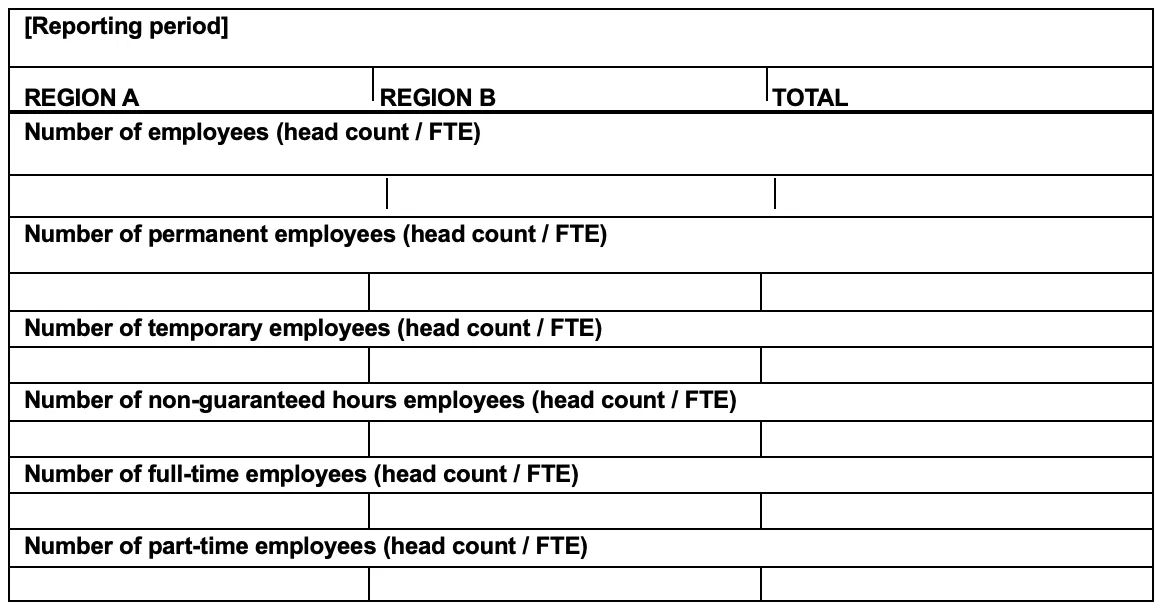
For the information specified in point (b) of paragraph 50, the undertaking may in addition disclose the breakdown by region.
-
The undertaking may disclose by head count or full time equivalent (FTE) the following information:
(a) full-time employees, and breakdowns by gender and by region; and
(b) part-time employees, and breakdowns by gender and by region.
Application Requirements
Section titled “Application Requirements”AR 53. This Disclosure Requirement covers all employees who perform work for any of the undertaking’s entities included in its sustainability reporting.
AR 54. Providing a breakdown of employees by country gives insight into the distribution of activity across countries. The number of employees in each country is also a key trigger for many information, consultation and participation rights for workers and workers’ representatives, both in the Union labour law acquis (for example, Directive 2009/38/EC of the European Parliament and of the Council [1] “European Works Councils Directive” and Directive 2002/14/EC of the European Parliament and of the Council[2] “Information and Consultation Directive”) and in national law (for example, rights to establish a works council or to have board level employee representation). Providing a breakdown of employees by gender and type of employment relationship gives insight into gender representation across the undertaking. Additionally, providing a breakdown of employees by region gives insight into regional variations. A region can refer to a country or other geographic locations, such as a region within a country or a world region.
AR 55. The undertaking shall disclose the requested disclosures in the following tabular formats:
Table 1: Template for presenting information on employee head count by gender
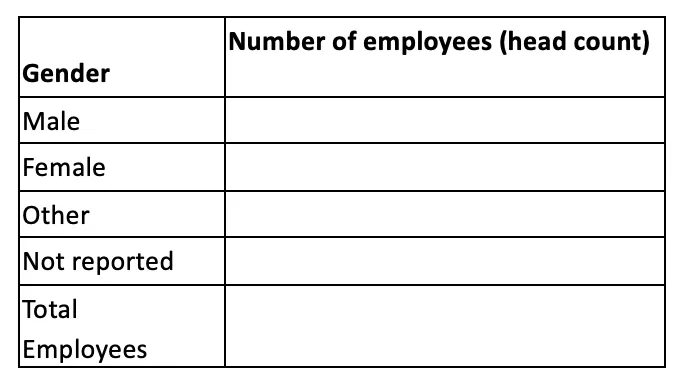
In some Member States it is possible for persons to legally register themselves as having a third, often neutral, gender, which is categorised as “other” in the table above. However, if the undertaking is disclosing data about employees where this is not possible, it may explain this and indicate that the “other” category is not applicable.
Table 2: Template for presenting employee head count in countries where the undertaking has at least 50 employees representing at least 10% of its total number of employees.
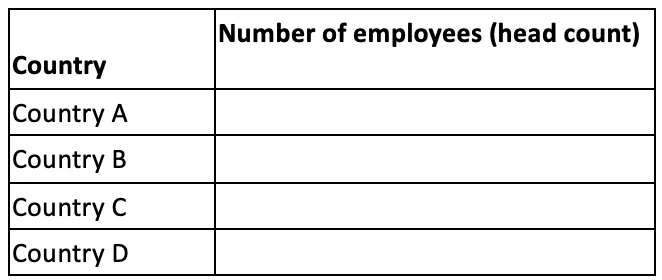
Table 3: Template for presenting information on employees by contract type, broken down by gender (head count or FTE) (reporting on full-time and part-time employees is voluntary)
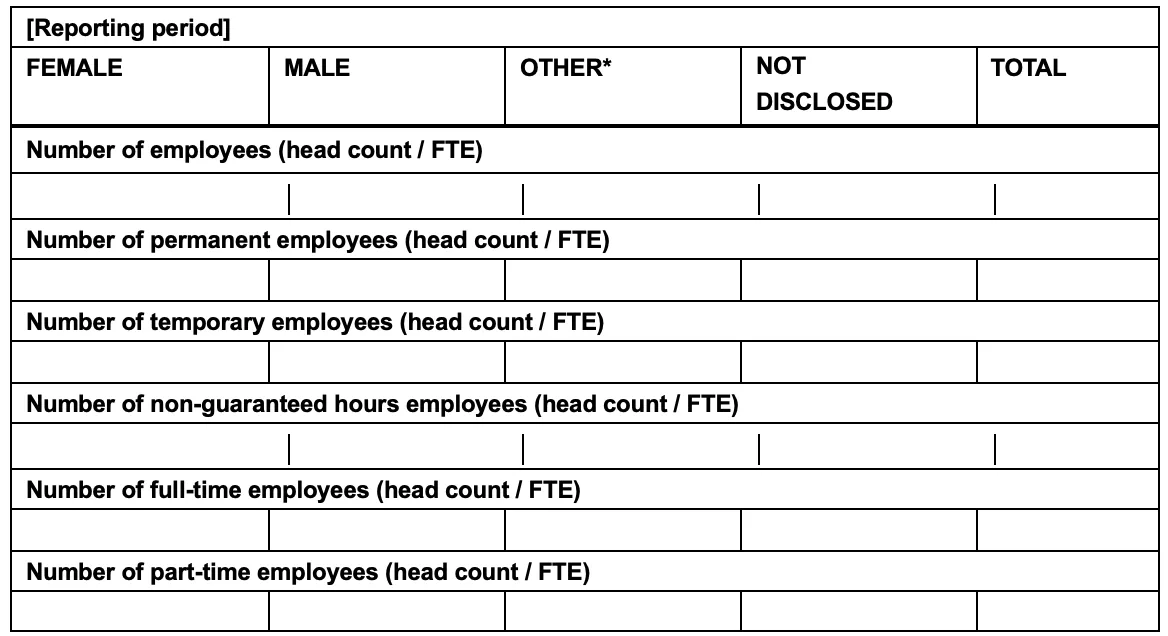
Table 4: Template for presenting information on employees by contract type, broken down by region (head count or FTE) (reporting on full-time and part-time employees is voluntary)
AR 56. The definitions of permanent, temporary, non-guaranteed hours, full-time, and part-time employees differ between countries. If the undertaking has employees in more than one country, it shall use the definitions as per the national laws of the countries where the employees are based to calculate country-level data. The country-level data shall then be added up to calculate total numbers, disregarding differences in national legal definitions. Non-guaranteed hours employees are employed by the undertaking without a guarantee of a minimum or fixed number of working hours. The employee may need to make themselves available for work as required, but the undertaking is not contractually obliged to offer the employee a minimum or fixed number of working hours per day, week, or month. Casual employees, employees with zero-hour contracts, and on-call employees are examples that fall under this category.
AR 57. Disclosing the number of employees at the end of the reporting period provides information for that point in time, without capturing fluctuations during the reporting period. Disclosing these numbers in averages across the reporting period takes into account fluctuations during the reporting period.
AR 58. Quantitative data, such as the number of temporary or part-time employees, is unlikely to be sufficient on its own. For example, a high proportion of temporary or part-time employees could indicate a lack of employment security for employees, but it could equally signal workplace flexibility when offered as a voluntary choice. For this reason, the undertaking is required to disclose contextual information to help information users interpret the data. The undertaking can explain the reasons for temporary employment. An example of such a reason is the recruitment of employees to undertake work on a temporary or seasonal project or event. Another example is the standard practice of offering a temporary contract (for example, six months) to new employees before an offer of permanent employment is made. The undertaking may also explain the reasons for nonguaranteed hours employment.
AR 59. For the own employee turnover calculation, the undertaking shall calculate the aggregate of the number of employees who leave voluntarily or due to dismissal, retirement, or death in service. The undertaking shall use this number for the numerator of the employee turnover rate and may determine the denominator used to calculate this rate and describe its methodology.
AR 60. Where data is not available for detailed information, the undertaking shall use an estimation of the employee number or ratios, in accordance with ESRS 1, and clearly identify where the use of estimates has taken place.