Mitigate platform’s Double Materiality Assessment methodology

Contents
- Summary
- The process
- The scoring system
- Scoring components
- Default configuration
- Scoring system configuration
- Materiality calculations
Summary
Section titled “Summary”The Mitigate platform’s Double Materiality Assessment (DMA) module helps companies assess their sustainability impacts, risks and opportunities in a structured and efficient way. It follows the European Sustainability Reporting Standards (ESRS), ensuring compliance and consistency in reporting.
→ How it works
Section titled “→ How it works”At its core, the Mitigate’s DMA methodology is based on four key elements:
- Sustainability topics – Topics related to a company’s environmental, social, and governance (ESG) impact.
- Impacts, risks, and opportunities – How the company affects the world and how sustainability issues affect the company.
- Assessments – Evaluations based on internal analysis and stakeholder input.
- Scoring system – A method to quantify and automate materiality assessments, making the process clear and audit-ready.
→ Key features
Section titled “→ Key features”- Guided assessments – The platform provides a step-by-step approach, making it easy for both beginners and experts to conduct a double materiality assessment.
- Stakeholder engagement – Companies can collect input from relevant parties and track feedback.
- Automated calculations – Materiality is calculated using a scoring system, reducing manual work while maintaining flexibility.
- Custom scoring system – Companies can define their own scoring factors, scoring options, and calculation formulas, allowing full flexibility in how materiality is assessed.
- Transparency & compliance – A built-in audit trail ensures that all assessments are well-documented and ESRS-compliant.
→ Assessing materiality
Section titled “→ Assessing materiality”The module evaluates two types of materiality:
- Impact materiality – Measures the company’s effect on people and the environment, based on scale, scope, irremediability, and likelihood.
- Financial materiality – Analyses financial risks and opportunities using magnitude and likelihood.
The final result is a detailed analysis of all ESRS sustainability topics, including:
- Materiality status (whether a topic is relevant for reporting)
- Time horizons (short-, medium- and long-term impacts, risks and opportunities)
- Value chain details (where impacts occur)
- Distinction between actual and potential, positive and negative impacts
→ Thresholds
Section titled “→ Thresholds”Companies can adjust materiality levels and thresholds to fit their specific needs, ensuring the assessment is both accurate and relevant.
→ Why use Mitigate’s DMA module?
Section titled “→ Why use Mitigate’s DMA module?”It’s an all-in-one solution for conducting ESRS-compliant double materiality assessments - simplifying sustainability reporting, reducing manual effort, and ensuring clarity in decision-making.
The process
Section titled “The process”The assessment process is designed to be flexible, allowing companies to start with the information they have and refine it over time. If a due diligence outcome, business model, or value chain is available, it serves as a valuable input—but these can also be added gradually.
Key steps in the process:
- The CSRD compliance process begins with a due diligence (DD) process, where a company assesses its operational framework. This involves a comprehensive evaluation of its activities, business relationships, geographic locations, and existing strategic, financial, and ESG policies. Key outcomes of the DD are:
The goal is to create a company-specific ESG map that reflects its unique characteristics, ensuring all relevant sustainability topics are considered. The outcome of the due diligence process should:
- Business model (canvas) 1. Core activities 2. Products and/or services 3. Geographic locations 4. Resources 5. Suppliers & partners 6. Customer groups 7. Revenue streams 8. Costs 9. Distribution channels 10. Stakeholders
- Business strategy and sustainability strategy (if exists)
- Financial statements
- Value chain mapping
- Company policies and procedures
- Provide a clear understanding of the company’s business and relationships.
- Support the identification of IROs.
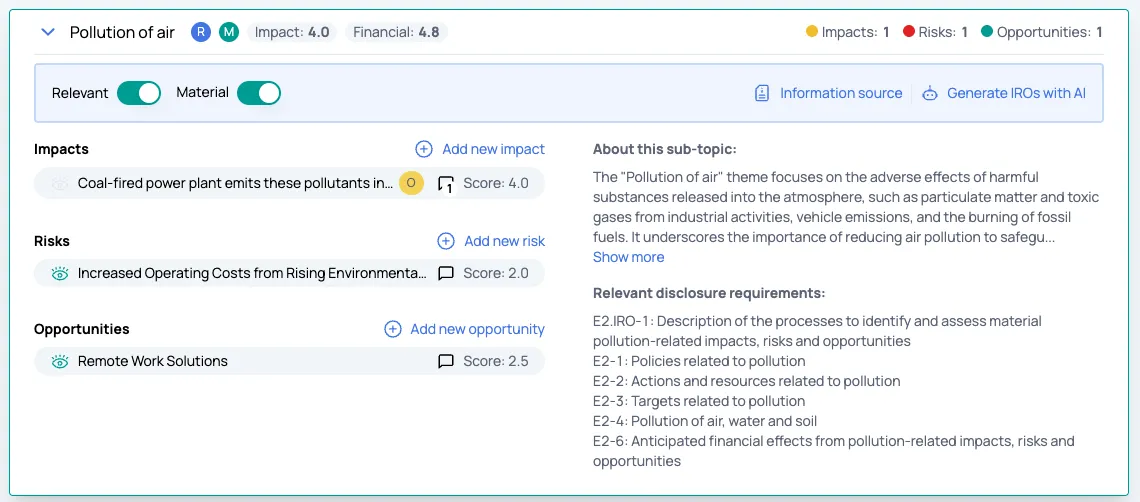
- Identifying relevant topics – Companies flag potentially relevant sustainability topics and can add custom topics not covered by ESRS. Example of a sustainability topic with relevance flag, materiality flag, IROs and scores:
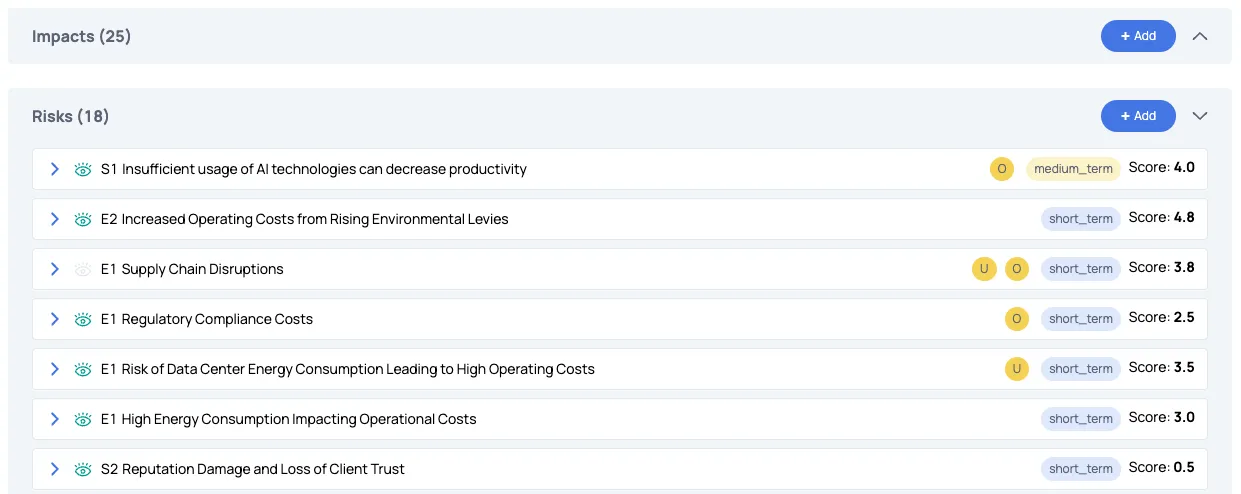
- Listing impacts, risks, and opportunities (IROs) – IROs are identified and linked to relevant topics, forming a long-list for further assessment. This step requires a company to take a deeper look at their sustainability topics, using resources like the ESRS, scientific research, media insights, peer reports, and other sustainability reporting frameworks. Example of IROs listing:
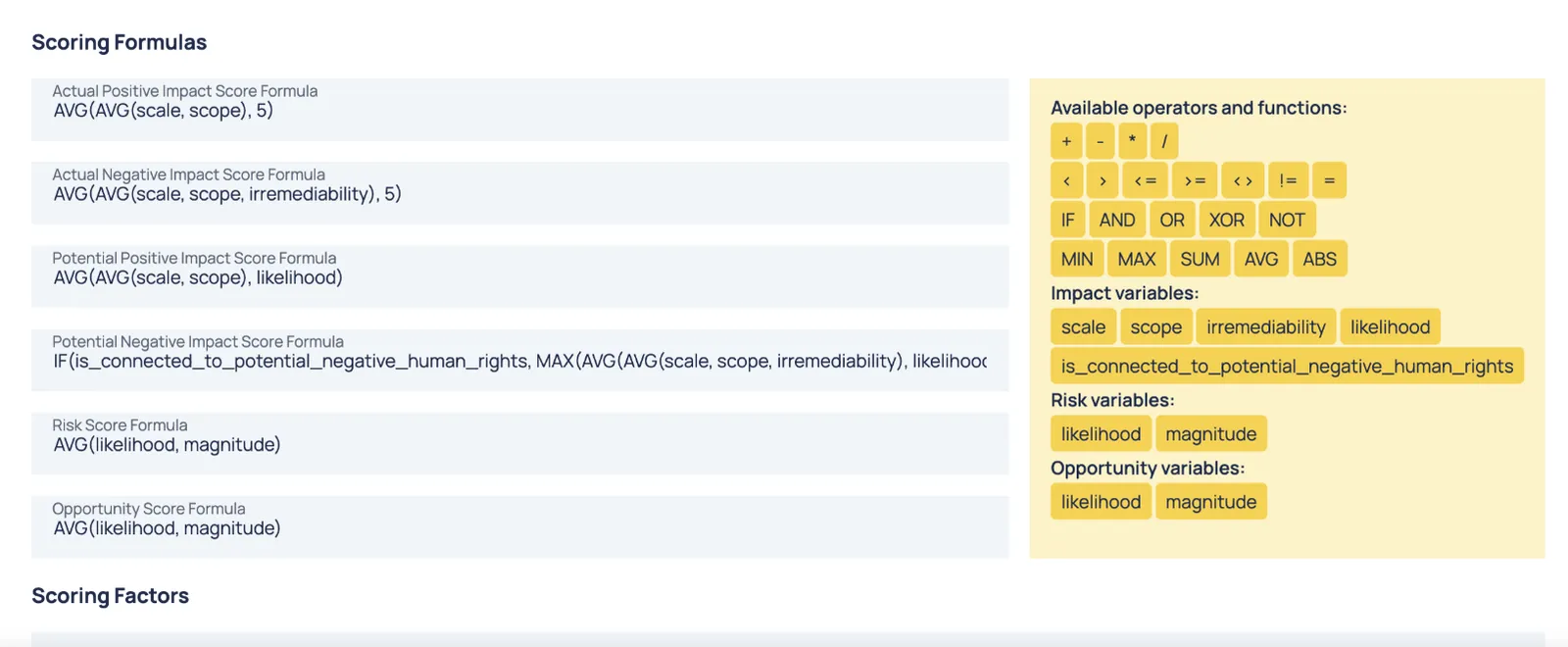
- Configuring the scoring system – Companies can use the default 5 point scoring system or customise it by defining their own factors, options, and calculation formulas. Example of scoring system configuration:
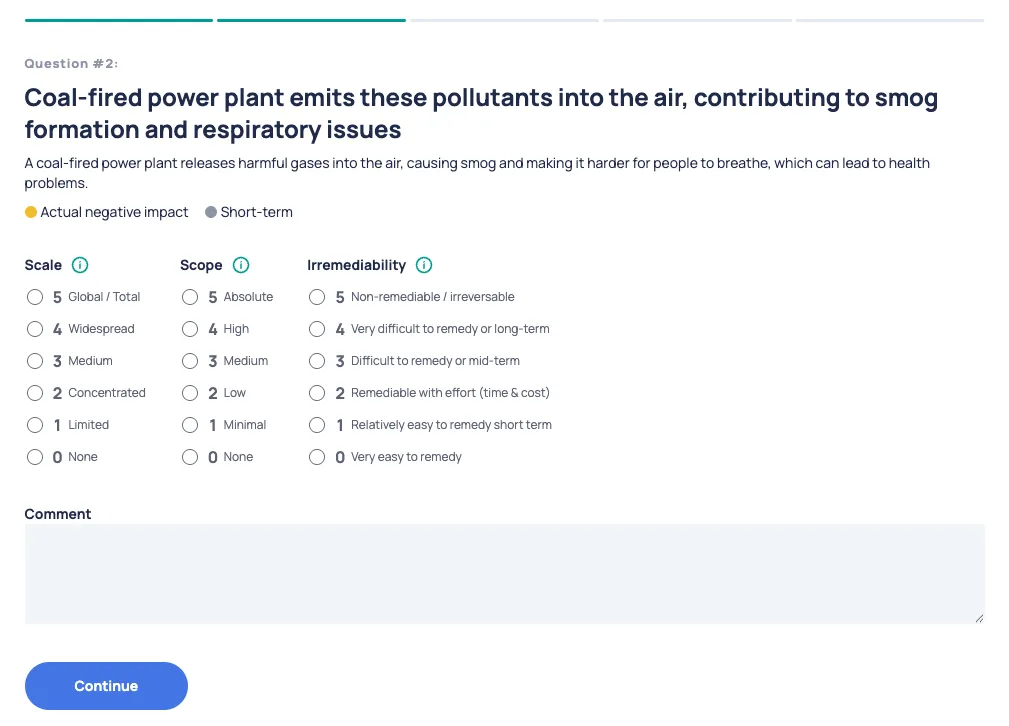
- Stakeholder engagement - Assessments can be added manually (based on workshops, interviews, or other external inputs) or automatically using the platform’s built-in DMA web surveys. Example of an assessment Web surveys:
- Materiality calculation – The scoring system is applied to evaluate IROs first, followed by the final materiality assessment of sustainability topics.
This approach ensures that companies can assess materiality, whether they follow a standard methodology or tailor it to their specific needs.
The scoring system
Section titled “The scoring system”Scoring components
Section titled “Scoring components”The scoring system consists of the following key components:
- Scoring factors: These are the elements used to evaluate materiality
- Scale
- Scope
- Likelihood
- Irremediability
- Magnitude
- Likelihood
- Factor assessment options (for each factor): Each scoring factor has predefined assessment levels. For example, the Scale factor may be rated as:
- 5 - Absolute
- 4 - High
- 3 - Medium
- 2 - Low
- 1 - Minimal
- 0 - None
- Scoring subjects: The system assesses different sustainability-related subjects, including:
- Actual positive impact
- Actual negative impact
- Actual negative impact connected to human rights
- Potential positive impact
- Potential negative impact
- Risk
- Opportunity
- Scoring subject formulas: Each subject is scored using predefined formulas. For example:
- Actual positive impact score formula:
AVG(AVG(scale, scope), 5) - Risk score formula:
AVG(likelihood, magnitude)
- Actual positive impact score formula:
- Materiality levels and Thresholds: Materiality is determined based on scoring outcomes. The thresholds can be customised, but a typical configuration is:
- Impacts
| Score Range | Materiality Level | Material? |
|---|---|---|
| ≤ 1 | Minimal | ❌ No |
| 1-2 | Informative | ❌ No |
| 2-3 | Important | ❌ No |
| 3-4 | Significant | ✅ Yes |
| > 4 | Critical | ✅ Yes |
- Risks and Opportunities
| Score Range | Materiality Level | Material? |
|---|---|---|
| ≤ 1 | Minimal | ❌ No |
| 1-2 | Informative | ❌ No |
| 2-3 | Important | ❌ No |
| 3-4 | Significant | ✅ Yes |
| > 4 | Critical | ✅ Yes |
- Sustainability topic materiality: A sustainability topic is considered material if any of the following exceed the defined thresholds:
- Connected impacts – the topic is material from an impact perspective.
- Connected risks and/or opportunities – the topic is material from a financial perspective.
- Both impacts and risks/opportunities – the topic is material from both perspectives.
Companies can adjust the default configuration to fit their specific needs by modifying scoring factors, factor options, subject formulas, and materiality thresholds.
To better understand how these components work together, please refer to the next section: “Default Configuration.”
Default configuration
Section titled “Default configuration”The platform includes a default scoring system, allowing companies to start their Double Materiality Assessment (DMA) without the need to develop their own scoring methodology from scratch.
Many companies outsource DMA to consultants, and since different consultants use different methodologies and scoring systems, we provide full customisation options. This allows companies to adjust the scoring system to align with a previously performed DMA or a consultant’s preferred approach.
Default configuration settings:
| Factors | Factor assessment options |
|---|---|
| Scale | 5 Absolute 4 High 3 Medium 2 Low 1 Minimal 0 None |
| Scope | 5 Global/Total 4 Widespread 3 Medium 2 Concentrated 1 Limited 0 None |
| Irremediability | 5 Non-remediable/ irreversible 4 Very difficult to remedy or long-term 3 Difficult to remedy or mid-term 2 Remediable with effort (time & cost) 1 Relatively easy to remedy short term 0 None |
| (Impact) Likelihood | 5 Very High 4 High 3 Medium 2 Low 1 Very Low 0 None |
| Magnitude | 5 Significant 4 Extensive 3 Moderate 2 Negligible 1 Insignificant |
| (R&O) Likelihood | 5 Very High 4 High 3 Medium 2 Low 1 Very Low |
| Subjects | Subject formula |
|---|---|
| Actual positive impact | AVG(AVG(scale, scope), 5) |
| Actual negative impact | AVG(AVG(scale, scope), likelihood) |
| Actual negative impact connected to human rights | IF( is_connected_to_potential_negative_human_rights, MAX(AVG(AVG(scale, scope, irremediability), likelihood), AVG(scale, scope, irremediability)), AVG(AVG(scale, scope, irremediability), likelihood) ) |
| Potential positive impact | AVG(AVG(scale, scope, irremediability), likelihood) |
| Potential negative impact | MAX(AVG(AVG(scale, scope, irremediability), likelihood), AVG(scale, scope, irremediability)) |
| Risk | AVG(likelihood, magnitude) |
| Opportunity | AVG(likelihood, magnitude) |
| Impact materiality levels | Threshold (material?) |
|---|---|
| Non-material (0 - 3.5) | False |
| Material (3.6 - 5) | True |
| Financial materiality levels | Threshold (material?) |
|---|---|
| Non-material (0 - 3.5) | False |
| Material (3.6 - 5) | True |
We use just 2 materiality levels. Another popular option used in the industry is to define 5 materiality levels:
Score Level Material? ≤ 1 Minimal False 1-2 Informative False 2-3 Important False 3-4 Significant True > 4 Critical True
Scoring system customisation
Section titled “Scoring system customisation”Companies can customise the scoring system to fit their specific needs by modifying the following components:
- Factors
- Factor assessment options
- Subject formulas
- Materiality levels and thresholds
With the platform’s scoring system customisation feature, various materiality calculation approaches can be configured. For example, companies can:
- Adjust default 5-point system with multiple materiality levels (matrix)
- Create a 3-point or 4-point scoring system
- Define materiality levels using a 2×2 or 5×5 matrix
This flexibility ensures that companies can align the scoring system with their internal methodologies or consultant-driven approaches.
Materiality calculations
Section titled “Materiality calculations”Each IRO can have two types of assessments:
- Own assessment (mandatory) – Conducted by the company’s experts, this represents the internal evaluation of the IRO based on available data, expertise, and strategic considerations.
- Stakeholder assessment (optional) – Includes all collected inputs from stakeholders, such as surveys, interviews, and consultations, providing external perspectives on the IRO’s significance and impact.
The scoring system does the following calculations, according to the configuration:
- Materiality score for each impact, according to:
- Submitted factor assessments (scale, scope, irremediability, likelihood)
- Configured subject formula: 1. Actual positive impact 2. Actual negative impact 3. Actual negative impact connected to human rights 4. Potential positive impact 5. Potential negative impact
- Materiality score for each risk, according to:
- Submitted factor assessments (likelihood, magnitude)
- Configured subject formula
- Materiality score for each opportunity, according to:
- Submitted factor assessments (likelihood, magnitude)
- Configured subject formula
- Topic impact materiality score = connected highest impact score
- Topic financial materiality score = connected highest risk or opportunity score