E1-7 – GHG removals and GHG mitigation projects financed through carbon credits
🗂️ ESRS E1 Climate Change, page 12-13
- The undertaking shall disclose:
(a) GHG removals and storage in metric tonnes of CO2eq resulting from projects it may have developed in its own operations, or contributed to in its upstream and downstream value chain; and
(b) the amount of GHG emission reductions or removals from climate change mitigation projects outside its value chain it has financed or intends to finance through any purchase of carbon credits.
- The objective of this Disclosure Requirement is:
(a) to provide an understanding of the undertaking’s actions to permanently remove or actively support the removal of GHG from the atmosphere, potentially for achieving net-zero targets (as stated in paragraph 60).
(b) to provide an understanding of the extent and quality of carbon credits the undertaking has purchased or intends to purchase from the voluntary market, potentially for supporting its GHG neutrality claims (as stated in paragraph 61).
- The disclosure on GHG removals and storage required by paragraph 56 (a) shall include, if applicable:
(a) the total amount of GHG removals and storage in metric tonnes of CO2eq disaggregated and separately disclosed for the amount related to the undertaking’s own operations and its upstream and downstream value chain, and broken down by removal activity; and
(b) the calculation assumptions, methodologies and frameworks applied by the undertaking.
- The disclosure on carbon credits required by paragraph 56 (b) shall include, if applicable:
(a) the total amount of carbon credits outside the undertaking’s value chain in metric tonnes of CO2eq that are verified against recognised quality standards and cancelled in the reporting period; and the total amount of carbon credits outside the undertaking’s value chain in metric tonnes of CO2eq planned to be cancelled in the future and whether they are based on existing contractual agreements or not.
-
In the case where the undertaking discloses a net-zero target in addition to the gross GHG emission reduction targets in accordance with Disclosure Requirement E1-4, paragraph 30, it shall explain the scope, methodologies and frameworks applied and how the residual GHG emissions (after approximately 90-95% of GHG emission reduction with the possibility for justified sectoral variations in line with a recognised sectoral decarbonisation pathway) are intended to be neutralised by, for example, GHG removals in its own operations and upstream and donwstream value chain.
-
In the case where the undertaking may have made public claims of GHG neutrality that involve the use of carbon credits, it shall explain:
(a) whether and how these claims are accompanied by GHG emission reduction targets as required by Disclosure requirement ESRS E1-4;
(b) whether and how these claims and the reliance on carbon credits neither impede nor reduce the achievement of its GHG emission reduction targets, or, if applicable, its net zero target; and
(c) the credibility and integrity of the carbon credits used, including by reference to recognised quality standards.
Application Requirements
Section titled “Application Requirements”GHG removals and storage in own operations and the upstream and downstream value chain
Section titled “GHG removals and storage in own operations and the upstream and downstream value chain”AR 56. In addition to their GHG emission inventories, undertakings shall provide transparency on how and to what extent they either enhance natural sinks or apply technical solutions to remove GHGs from the atmosphere in their own operations and upstream and downstream value chain. While there are no generally accepted concepts and methodologies for accounting for GHG removals, this Standard aims to increase transparency on the undertaking’s efforts to remove GHGs from the atmosphere (paragraphs 56 (a) and 58). The GHG removals outside the value chain that the undertaking supports through the purchase of carbon credits are to be disclosed separately as required by paragraphs 56 (b) and 59.
AR 57. When disclosing the information on GHG removals and storage from the undertaking’s own operations and its upstream and downstream value chain required under paragraphs 56 (a) and 58, for each removal and storage activity, the undertaking shall describe:
(a) the GHGs concerned;
(b) whether removal and storage are biogenic or from land-use change (e.g., afforestation, reforestation, forest restoration, urban tree planting, agroforestry, building soil carbon, etc.), technological (e.g., direct air capture), or hybrid (e.g., bioenergy with CO2 capture and storage), and technological details about the removal, the type of storage and, if applicable, the transport of removed GHGs;
(c) if applicable, a brief explanation of whether the activity qualifies as a nature-based solution; and
(d) how the risk of non-permanence is managed, including determining and monitoring leakage and reversal events, as appropriate.
Calculation guidance
AR 58. When preparing the information on GHG removals and storage from the undertaking’s own operations and its upstream and downstream value chain required under paragraphs 56 (a) and 58, the undertaking shall:
(a) consider, as far as applicable, the GHG Protocol Corporate Standard (version 2004), Product Standard (version 2011), Agriculture Guidance (version 2014), Land use, landuse change, and forestry Guidance for GHG project accounting (version 2006);
(b) apply consensus methods on accounting for GHG removals as soon as they are available, notably the EU regulatory framework for the certification of CO2 removals;
(c) if applicable, explain the role of removals for its climate change mitigation policy;
(d) include removals from operations that it owns, controls, or contributes to and that have not been sold to another party through carbon credits;
(e) if applicable, mark those GHG removal activities in own operations or the value chain that have been converted into carbon credits and sold on to other parties on the voluntary market;
(f) account for the GHG emissions associated with a removal activity, including transport and storage, under Disclosure Requirement E1-6 (Scopes 1, 2 or 3). To increase transparency on the efficiency of a removal activity, including transport and storage, the undertaking may disclose the GHG emissions associated with this activity (e.g., GHG emissions from electricity consumption of direct air capture technologies) alongside, but separately from, the amount of removed GHG emissions;
(g) in case of a reversal, account for the respective GHG emissions as an offset for the removals in the reporting period;
(h) use the most recent GWP values published by the IPCC based on a 100-year time horizon to calculate CO2eq emissions of non-CO2 gases and describe the assumptions made, methodologies and frameworks applied for calculation of the amount of GHG removals; and
(i) consider nature-based solutions.
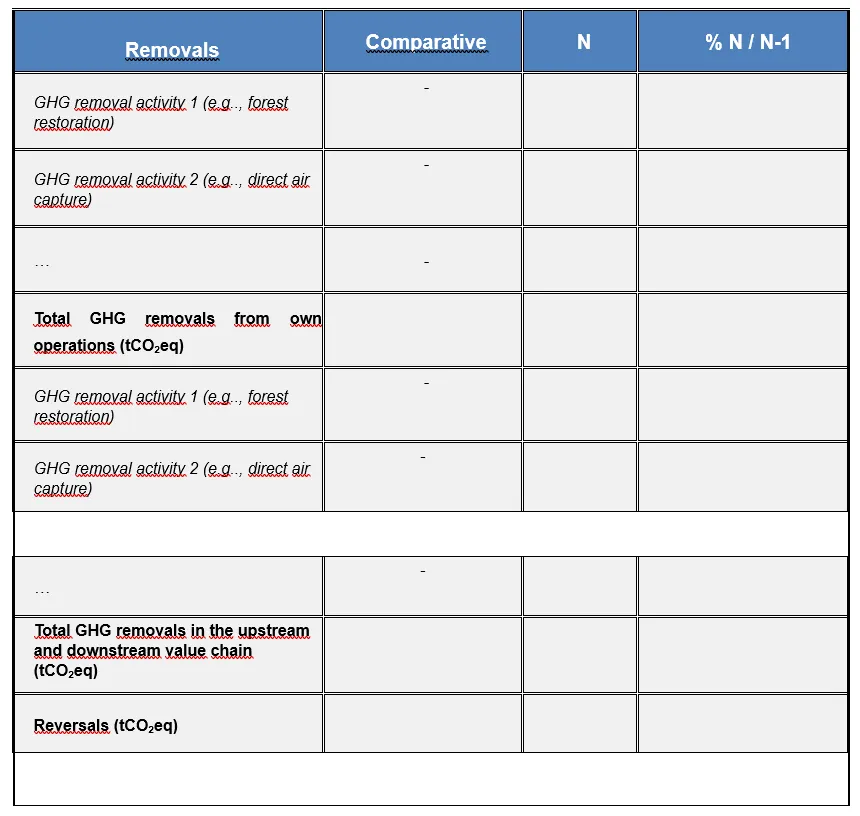
AR 59. The undertaking shall disaggregate and separately disclose the GHG removals that occur in its own operations and those that occur in its upstream and downstream value chain. GHG removal activities in the upstream and downstream value chain shall include those that the undertaking is actively supporting, for example, through a cooperation project with a supplier. The undertaking is not expected to include any GHG removals that may occur in its upstream and downstream value chain that it is not aware of.
AR 60. The quantitative information on GHG removals may be presented by using the following tabular format.
GHG mitigation projects financed through carbon credits
Section titled “GHG mitigation projects financed through carbon credits”AR 61. Financing GHG emission reduction projects outside the undertaking’s value chain through purchasing carbon credits that fulfil high-quality standards can be a useful contribution towards mitigating climate change. This Standard requires the undertaking to disclose whether it uses carbon credits separately from the GHG emissions (paragraphs 56 (b) and 59) and GHG emission reduction targets (Disclosure Requirement E1-4). It also requires the undertaking to show the extent of use and which quality criteria it uses for those carbon credits.
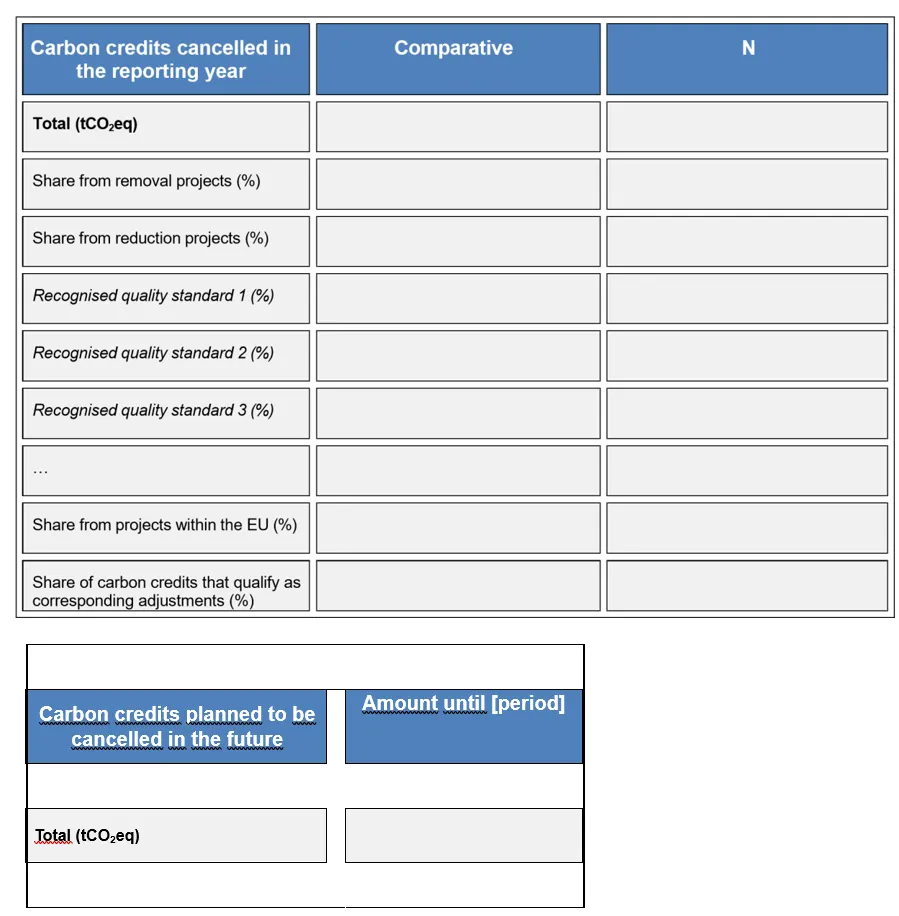
AR 62. When disclosing the information on carbon credits required under paragraphs 56 (b) and 59, the undertaking shall disclose the following disaggregation as applicable:
(a) the share (percentage of volume) of reduction projects and removal projects;
(b) for carbon credits from removal projects, an explanation whether they are from biogenic or technological sinks;
(c) the share (percentage of volume) for each recognised quality standard;
(d) the share (percentage of volume) issued from projects in the EU; and
(e) the share (percentage of volume) that qualifies as a corresponding adjustment under Article. 6 of the Paris Agreement.
Calculation guidance
AR 63. When preparing the information on carbon credits required under paragraphs 56 (b) and 59, the undertaking shall:
(a) Consider recognised quality standards;.
(b) if applicable, explain the role of carbon credits in its climate change mitigation policy;
(c) not include carbon credits issued from GHG emission reduction projects within its value chain as the respective GHG emission reductions shall already be disclosed under Disclosure Requirement E1-6 (Scope 2 or Scope 3) at the time they occur (i.e., double counting is avoided);
(d) not include carbon credits from GHG removal projects within its value chain as the respective GHG removals may already be accounted for under Disclosure Requirement E1-7 at the time they occur (i.e., double counting is avoided);
(e) not disclose carbon credits as an offset for its GHG emissions under Disclosure Requirement E1-6 on GHG emissions;
(f) not disclose carbon credits as a means to reach the GHG emission reduction targets disclosed under Disclosure Requirement E1-4; and
(g) calculate the amount of carbon credits to be cancelled in the future, as the sum of carbon credits in metric tonnes of CO2eq over the duration of existing contractual agreements.
AR 64. The information on carbon credits cancelled in the reporting year and planned to be cancelled in the future may be presented using the following tabular formats.