B7 – Resource use, circular economy and waste management
🗂️ VSME Basic Module – Environment metrics, page 10
-
The undertaking shall disclose whether it applies circular economy principles and, if so, how it applies these principles.
-
The undertaking shall disclose:
(a) the total annual generation of waste broken down by type (non-hazardous and hazardous);
(b) the total annual waste diverted to recycling or reuse; and
(c) if the undertaking operates in a sector using significant material flows (for example manufacturing, construction, packaging or others), the annual mass-flow of relevant materials used.
🗂️ VSME Basic Module Guidance – Environmental Metrics, page 34-38
Guidance on circular economy principles
- When disclosing information on its products, material use and waste management, the undertaking may provide information in relation to circular economy principles. Circular economy principles are articulated in the paragraphs below. The key principles outlined by the Ellen Macarthur Foundation are underlined below while the key principles considered by the European Commission are italicised.
Eliminate waste and pollution – this can be done through process improvements and also through design considerations at the level of usability, reusability, repairability, disassembly and remanufacturing.
Circulate products and materials (at their highest value) – reusability and recycling are key for product circulation, but this is enhanced if special consideration is given to circularity at the design phase for issues such as usability, reusability, repairability, remanufacturing and disassembly. Factors such as the incorporation of biomaterials and their recirculation via the biological cycle can also be considered, for example using biodegradable crop covers instead of plastics in agriculture.
Regenerate nature – whenever possible, human activities should seek to regenerate nature and improve or restore key ecological functions (i.e. drainage, habitat provision, thermal regulation, etc.) that may have been lost due to previous human activities.
Guidance on total waste generation and waste diverted to recycling or reuse
-
The requirements in paragraph 38 may be omitted by undertakings that generate only household waste. In such cases, the undertaking will only state that it generates this type of waste.
-
When reporting on hazardous waste according to paragraph 38(a), the undertaking fulfils the requirements on radioactive waste of indicator number 9 from Table #1 of Annex 1 of the Sustainable Finance Disclosure Regulation (SFDR)[10] . This SFDR indicator (ratio between tonnes of radioactive and hazardous waste) can be computed by using the numerator and denominator that the undertaking provides when reporting according to paragraph 38(a).
-
SMEs must disclose hazardous and radioactive waste if their operations involve generating such waste. Applicability depends on the presence of hazardous or radioactive materials in business processes.
-
Undertakings are recommended to classify their hazardous waste using the European Waste Catalogue (EWC), which categorises waste by type. Any waste marked with an asterisk (*) is classified as hazardous in the EWC, normally with reference to ‘containing hazardous substances’. For example:
(a) medical sector: contaminated sharps like needles and syringes used in medical settings (‘wastes whose collection and disposal is subject to special requirements in order to prevent infection’ EWC Code 18 01 03*), cytotoxic and cytostatic medicines (EWC Code 18 01 08*), spent radiopharmaceuticals, and certain diagnostic equipment containing radioactive materials;
(b) manufacturing sector: used lubricants and oils classified as hazardous (EWC Code 13 02 05*);
(c) construction sector: asbestos-containing materials (EWC Code 17 09 03*), soil and stones containing hazardous substances (EWC Code 17 05 03*), and
(d) batteries and accumulators: lead batteries (16 06 01*), Ni-Cd batteries (16 06 02*), batteries containing mercury (16 06 03*).
-
Nevertheless, a waste is considered hazardous if it displays one or more of the hazardous properties listed in Annex II of the Waste Framework Directive. For easier reference, these are presented below together with the respective pictograms to help identify hazardous properties such as flammability, toxicity and corrosiveness, which may lead to waste being classified as hazardous.
-
Radioactive waste also has or can have hazardous properties that render it hazardous, namely carcinogenic, mutagenic or toxic for reproduction. Nevertheless, radioactive substances are subject to separate regulations within the EU[11]. Companies using radioactive materials with the ability of generating radioactive waste subject to EU regulation should be aware of it. Radioactive waste should be identified based on the presence of radionuclides at levels above regulatory clearance thresholds.
-
Radioactive waste can be present in a variety of items such as medical, research and industrial equipment, smoke detectors, or sludges.
-
Hazard Pictograms for each hazard class are presented below.
| Hazard pictogram | Pictogram statement, symbol and class | What does it mean? |
|---|---|---|
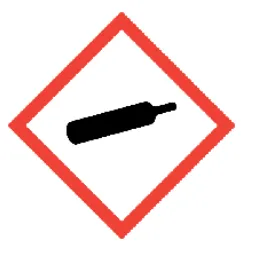 |
‘Gas under pressure’ Symbol: Gas cylinder Physical Hazard | • Contains gas under pressure; may explode if heated • Contains refrigerated gas; may cause cryogenic burns or injury |
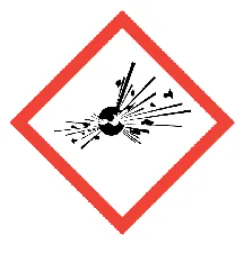 |
‘Explosive’ Symbol: Exploding bomb Physical Hazard | • Unstable explosive • Explosive; mass explosion hazard • Explosive; severe projection hazard • Explosive; fire, blast or projection hazard • May mass explode in fire |
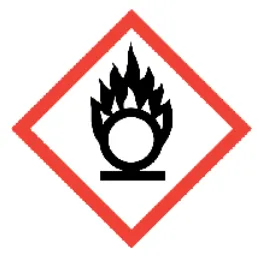 |
‘Oxidising’ Symbol: Flame over circle Physical Hazard | • May cause or intensify fire; oxidiser. • May cause fire or explosion; strong oxidiser. |
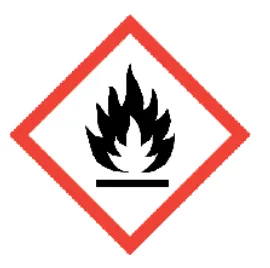 |
‘Flammable’ Symbol: Flame Physical Hazard | • Extremely flammable gas • Flammable gas • Extremely flammable aerosol • Flammable aerosol • Highly flammable liquid and vapour • Flammable liquid and vapour • Flammable solid |
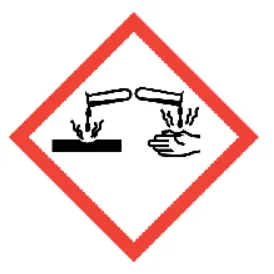 |
‘Corrosive’ Symbol: Corrosion Physical Hazard / Health Hazard | • May be corrosive to metals • Causes severe skin burns and eye damage |
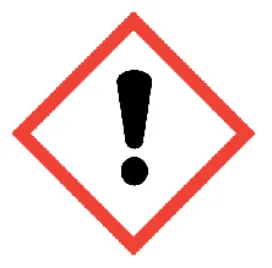 |
‘Health hazard/Hazard ous to the ozone layer’ Symbol: Exclamation mark Health Hazard | • May cause respiratory irritation • May cause drowsiness or dizziness • May cause an allergic skin reaction • Causes serious eye irritation • Causes skin irritation • Harmful if swallowed • Harmful in contact with skin • Harmful if inhaled • Harms public health and the environment by destroying ozone in the upper atmosphere |
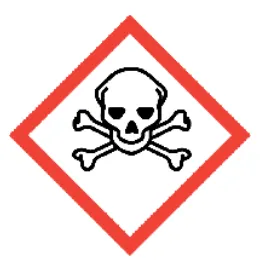 |
‘Acute toxicity’ Symbol: Skulls and Crossbones Health Hazard | • Fatal if swallowed • Fatal in contact with skin • Fatal if inhaled • Toxic: if swallowed • Toxic in contact with skin • Toxic if inhaled |
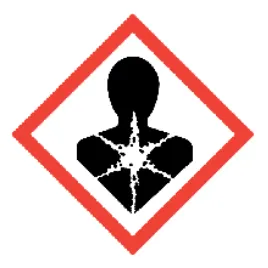 |
‘Serious health hazard’ Symbol: Health Hazard Health Hazard | • May be fatal if swallowed and enters airways • Causes damage to organs • May cause damage to organs • May damage fertility or the unborn child • Suspected of damaging fertility or the unborn child • May cause cancer • Suspected of causing cancer • May cause genetic defects • Suspected of causing genetic defects • May cause allergy or asthma symptoms or breathing difficulties if inhaled |
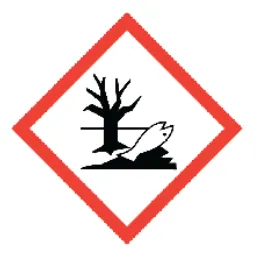 |
‘Hazardous to the environment’ Symbol: Environment Environmental Hazard | • Very toxic to aquatic life with long-lasting effects • Toxic to aquatic life with long-lasting effects |
Pictograms that indicate hazardous properties, Annex V, from the Classification, Labelling and Packaging (CLP) Regulation (EC) No 1272/2008.
-
When presenting information on its waste generation or diversion from disposal, the undertaking should preferably report such information in units of weight (e.g. kg or tonnes). Nevertheless, should the units of weight be considered an inappropriate unit by the undertaking, they may alternatively disclose the aforementioned metrics in volumes (e.g. m3) instead.
-
When disclosing information on the total annual waste diverted to recycling or reuse, the undertaking should consider the waste that is sorted and sent to recycling or reuse operators (e.g. the amount of waste put into recycling container or sorting of waste into certain categories of materials and their delivery to waste treatment facilities) rather than the waste that gets effectively recycled or reused.
-
When disclosing information on waste, the undertaking may adopt the following tables
| Waste generated (e.g. tonnes) | |
|---|---|
| Total waste generated, of which: | |
| Non-hazardous waste | |
| Type of waste1 | |
| Type of waste2 | |
| … | |
| Hazardous waste | |
| Type of waste1 | |
| … |
-
Examples of hazardous wastes that small businesses may generate include batteries, used oils, pesticides, mercury-containing equipment and fluorescent lamps.
-
The undertaking may provide further breakdowns specifying further types of non-hazardous and hazardous wastes. In doing so, it may consider the list of waste descriptions found in the European Waste Catalogue’s social metrics.
Guidance on the annual mass-flow of relevant materials used
- The annual mass-flow is an indicator aligned with the EMAS requirements on efficiency of material consumption, and it illustrates an undertaking’s dependency on specific materials in its operations (e.g. wood and steel for the construction industry). The undertaking is here required to provide information on the materials it uses, including both the materials acquired from suppliers and those sourced internally from production. To compute the annual mass-flow of the relevant materials it has used, the undertaking will need to first identify the specific key materials on which its operations are dependent and for which material efficiency needs to be evaluated (e.g. material efficiency of wood). If different types of materials are used, the undertaking will need to provide separately the annual mass-flow (i.e. total weight for each relevant material used, e.g. tonnes of wood purchased) for each key material in an appropriate manner, for example by breaking it down by the use to which they are put (EMAS, 2023). The mass flow of relevant materials used will result from the sum of the weight of all used materials, including raw materials, auxiliary materials, input materials, semi-finished products or others (excluding energy sources and water) and provide the total weight for each relevant material used (e.g. tonnes of wood purchased). The mass flow of relevant materials used will result from the sum of the weight of all used materials, including raw materials, auxiliary materials, input materials, semi-finished products, or others (excluding energy sources and water).This indicator is to be preferably expressed in units of weight (e.g. kilograms or tonnes), volume (e.g. m³) or other metric units commonly used in the sector.
Guidance on how to identify manufacturing, constructions and /or packaging processes
- To identify manufacturing, construction and/or packaging processes, the undertaking may refer to the activities that fall under Section C – Manufacturing, Section F – Construction as well as Class N82.92 ‘Packaging activities’ of Annex I to Regulation (EC) No 1893/2006 [12] .
[10] Regulation (EU) 2019/2088 of the European Parliament and of the Council of 27 November 2019 on sustainability-related disclosures in the financial services sector (Sustainable Finance Disclosures Regulation) (OJ L 317, 9.12.2019, p. 1).
[11] EU’s Radioactive Waste and Spent Fuel Management Directive (2011/70/Euratom). For more information see the EU’s webpage on Radioactive Waste and spent fuel.