B6 – Water
🗂️ VSME Basic Module – Environment metrics, page 10
-
The undertaking shall disclose its total water withdrawal, i.e. the amount of water drawn into the boundaries of the organisation (or facility); in addition, the undertaking shall separately present the amount of water withdrawn at sites located in areas of high water-stress.
-
If the undertaking has production processes in place which significantly consume water (e.g. thermal energy processes like drying or power production, production of goods, agricultural irrigation, etc.), it shall disclose its water consumption calculated as the difference between its water withdrawal and water discharge from its production processes.
🗂️ VSME Basic Module Guidance – Environmental Metrics, page 30-34
Guidance on how to calculate and report on water withdrawals and water consumption
-
Water withdrawal relates to the amount of water an undertaking draws into its organisational boundaries from any source during the reporting period. In practice, for most undertakings this relates to the amount of water taken from the public water supply network as indicated in the utility bills. However, where applicable, water withdrawal also includes amounts of water taken from other sources such as groundwater from own wells, water taken from rivers or lakes or water received by other undertakings. In the specific case of undertakings operating in agriculture, water withdrawal would include rainwater if collected directly and stored by the undertaking.
-
Water withdrawal data can be retrieved from measurements using flow meters or water bills; indeed, in practice for most undertakings water withdrawal relates to the amount of water taken from the public water supply network as indicated in the utility bills. In cases in which direct measurements are not feasible or are deemed not sufficient and therefore need to be complemented, data on water withdrawal can be estimated using, for example, calculations models, and industry standards.
-
For example, in the case of a shared office or coworking space, a possible method to calculate the water withdrawal could be to retrieve the overall water withdrawal of the building from the water bill and calculate the water withdrawal per employee with the following equation:
Water withdrawal per employee daily (L) = annual water withdrawal (L) / (n. of employees in the whole shared building x n. of working days).
The undertaking could then multiply the water withdrawal per employee for the number of its employees and the days they worked in the reporting year to obtain the final number required in the datapoint.
To make a numerical example applying the proposed formula, the annual water withdrawal retrieved from the water bill of a coworking space is 1296 m3 (corresponding to 1296000 L), coworking space where 100 employees of different companies work together for an assumed number of 240 days a year. The assumption on the average number of days worked can be based on national statistics, for example. The water withdrawal per employee daily would be in this case:
water withdrawal per employee daily = 1296000 L / (100x240) = 54 L
-
Assuming now that that the employees of the reporting undertaking are 25 and that they use the coworking space for 220 days a year, the yearly water withdrawal of the undertaking in the coworking space would be the water withdrawal per employee multiplied for the number of its employees and the days worked, therefore 54Lx25x220 = 297000 L (corresponding to 297 m3).
-
This calculation could be useful when it is possible to access the water bill of the shared building. This simple calculation method has some limitations, as it does not consider, for example, differences in use between different parts of the building (e.g. a seven-floor building could have six floors dedicated to offices and one floor with a canteen or a restaurant), which the undertaking might be able to overcome if additional data are available, further refining the basic calculation provided above as an example.
-
An alternative way to obtain water withdrawal data in the example of shared offices when it is not possible to retrieve the water bill could be to calculate it using fixture flow rates and occupancy data as primary inputs. A possible formula could be:
Total water withdrawal = ∑(Flow Rate×Number of Uses per Day×Number of Days per Year×Occupancy) where:
(a) flow rates or each fixture can be retrieved from the project documentation or labels of the fixtures, for example, or estimated basing on average data publicly available if more accurate information is not retrievable;
(b) the number of uses per day can be estimated based on averages publicly available;
(c) ‘number of days’ stands for the number of operational days for the reporting undertaking in a year;
(d) ‘occupancy’ represents the number of employees of the undertaking using the office; it is often calculated as full-time equivalent (FTE); and
(e) the sign ∑ indicates that the calculations for each fixture should be summed up to obtain the total water withdrawal of the reporting undertaking operating in a shared office.
-
An additional possible source that could support the reporting of water withdrawal for undertakings operating in shared offices is the JRC Level(s) indicator 3.1: Use stage water consumption user manual as well as additional related documents and calculation sheets (see PG Section Documents | Product Bureau (europa.eu)). Furthermore, the undertaking could consult EMAS Reference Document for the Public Administration sector and EMAS Reference Document for the Construction sector as well as rating systems like the National Australian Built Environment Rating System (NABERS) and certifications like the Building Research Establishment Environmental Assessment Method (BREEM), the Leadership in Energy and Environmental Design (LEED) and the German Sustainable Building Council (DGNB) System for Buildings In Use, which might provide useful indications in their methodologies on how to further refine the calculation for water withdrawal in offices and shared spaces.
-
The provided examples to obtain water withdrawal data in the case of shared offices can be transposed to and applied by undertakings operating in different sectors, with adjustments that might be necessary for the sectoral and entity-specific situation the undertaking operates in. EMAS Sectoral Reference Documents (SRDs) could be consulted for sector-specific methodology and indicators on water withdrawal as well as industry standards and benchmarks.
-
Water consumption is the amount of water drawn into the boundaries of the undertaking that is not discharged or planned to be discharged back into the water environment or to a third party. This typically relates to water evaporated – e.g. in thermal energy processes like drying or power production – water embedded in products – e.g. in food production – or water for irrigation purposes – e.g. used in agriculture or for watering company premises.
-
Water discharge means, for example, the amount of water transferred directly to receiving water bodies such as lakes or rivers, the public sewer or to other companies for cascading water use. It can be seen as the water output of the undertaking.
-
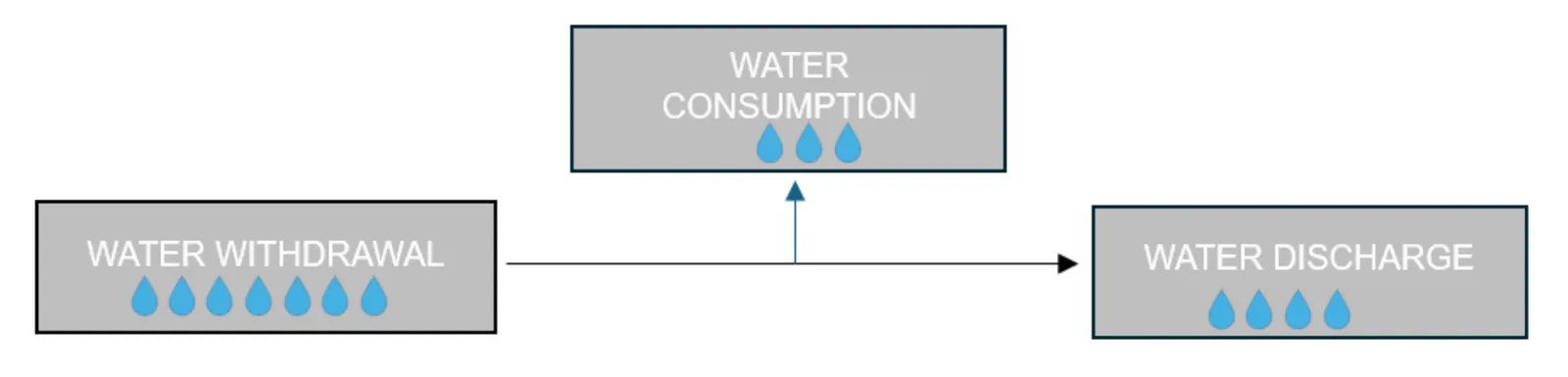
Water consumption can therefore be calculated as:
Water consumption = Water Inputs – Water Outputs
or in other words:
Water consumption = (Water withdrawal) – Water discharges.
For undertakings that solely withdraw water from the public water network and discharge it into the sewer, water consumption will be close to zero and can therefore be omitted from the report.
More broadly, the applicability of the disclosure requirement on water consumption relates to information already requested by law, already reported, and/or appropriate for the sector.
- A schematic view of the relationship between water withdrawal, water consumption and water discharge can be seen in the image below.
-
The undertaking may provide additional explanatory information to contextualise its water withdrawals or consumption. For example, the undertaking may highlight if rainwater is collected and used as a replacement for tap water or if water is discharged into other parties for cascading use.
-
Below can be found an example of how undertakings may present quantitative information on their withdrawals, discharges and consumption of water divided by site location.
| Water withdrawal E.g. m³ | Water consumption E.g. m³ (if applicable) | |
|---|---|---|
| All sites | ||
| Sites in areas with water stress |
Guidance for determining whether the undertaking operates in an area of high-water stress
-
The undertaking can consult local (e.g. national, regional) water authorities of the place(s) it operates in to inform its assessment of water resources for the specific location(s), including the identification of areas of high-water stress. The undertaking can also consult publicly available and free tools that map out water scarcity globally. One such tool is the WRI’s Aqueduct Water Risk Atlas, which provides an interactive map of a water stress indicator (the ‘baseline water stress’, which measures the ratio of total water demand to available renewable surface and groundwater supplies) at sub-basin level. With the help of this tool, undertakings can consult the water stress baseline set for different river basins globally. Values of the baseline water stress indicator above 40% indicate an area of high-water stress.
-
By way of illustration, the map below shows the main Iberian River basins and their water stress classification according to the WRI Aqueduct.
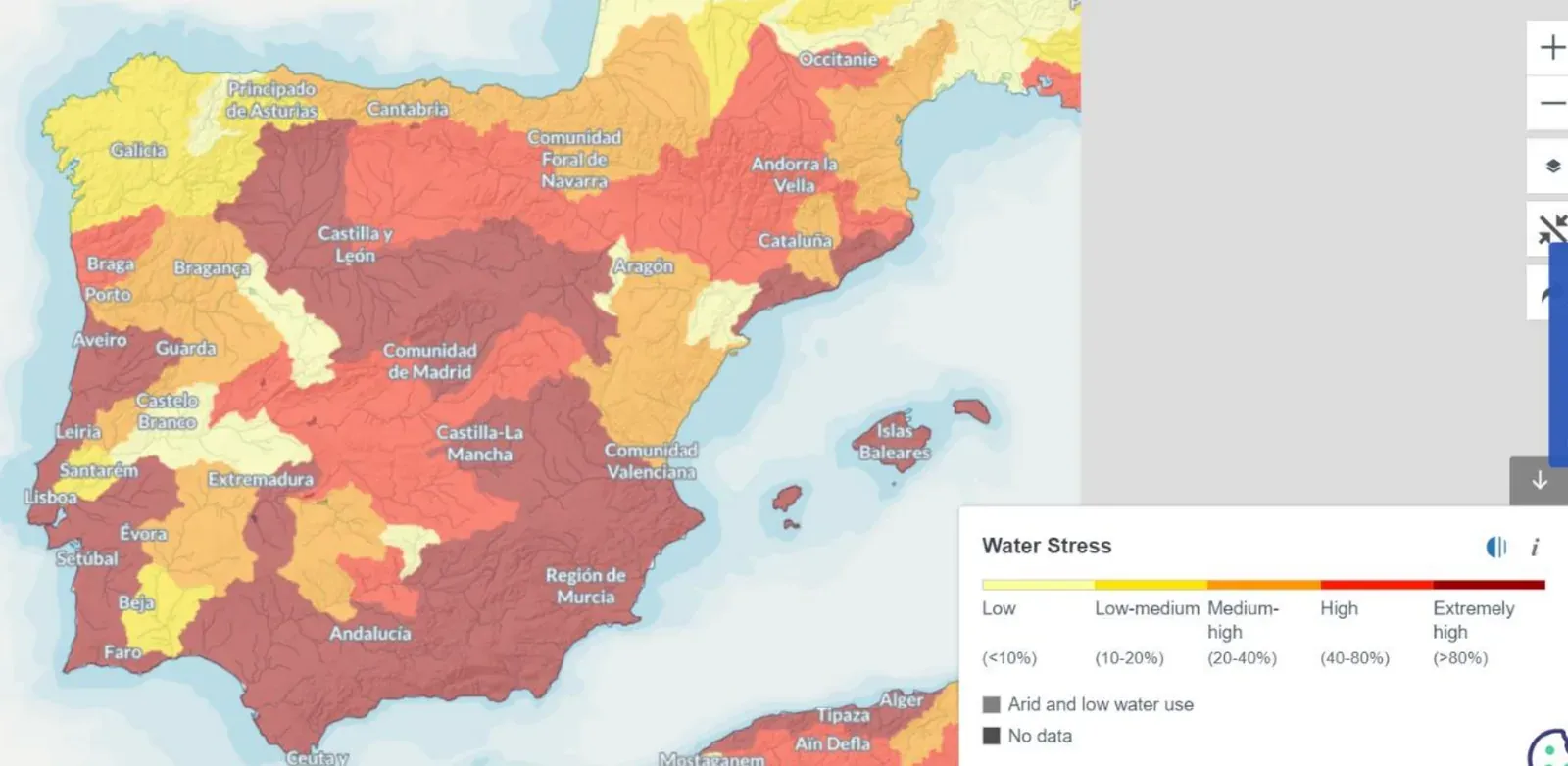
In this image several water basins in the Iberian Peninsula, along with their water stress classification, can be observed. Most of the southern part of the peninsula sits in an area of significant high-water stress – with the exception of the Guadiana basin (in yellow). Thus, if the undertaking has operations within the Guadalquivir basin (e.g. the Andalucia region, which has a significant high-water stress level), the undertaking would have to disaggregate its water consumption for that region/water basin. But if its operations take place within the southern part of the Guadiana river basin (where there is low water stress), then it would not be necessary to disaggregate its water consumption for that region/water basin.
- Other possible tools that undertakings can consult to determine their location in water stressed areas are the static map (and related dataset) provided by the European Environment Agency (EEA) Water Exploitation Index plus (WEI+) for summer and Urban Morphological Zones (UMZ) and the interactive map Water exploitation index plus (WEI+) for river basin districts (1990-2015), both presenting the water stress indicator WEI+ that measures total water consumption as a percentage of the renewable freshwater resources at sub-basin level. WEI+ values equal or greater than 40% generally indicate situations of high-water stress. It is worth underlining that WRI Aqueduct bases its baseline water stress indicator on water demand, while the EEA indicator of water stress WEI+ is based on water consumption.
Documentation Sources:
Water withdrawal in shared offices (measurement) ‘Water use in your business’, South Staff Water
Water withdrawal in shared offices (measurement, estimation) Level(s) indicator 3.1: Use stage water consumption user manual: introductory briefing, instructions and guidance (Publication version 1.1), JRC
Water withdrawal (general) EMAS User Guide
Water withdrawal in SMEs EMAS “easy” for small and medium enterprises
Water stress – WRI Aqueduct Technical Note - Aqueduct 4.0: Updated decision-relevant global water risk indicators, WRI
Water stress – WEI+ Water scarcity conditions in Europe (Water exploitation index plus) | European Environment Agency’s home page (europa.eu)