G1-3 – Prevention and detection of corruption and bribery
🗂️ ESRS G1 Business Conduct, page 4-5
-
The undertaking shall provide information about its system to prevent and detect, investigate, and respond to allegations or incidents relating to corruption and bribery including the related training.
-
The objective of this Disclosure Requirement is to provide transparency on the key procedures of the undertaking to prevent, detect, and address allegations about corruption and bribery. This includes the training provided to own workers and/or information provided internally or to suppliers.
-
The disclosure required under paragraph 16 shall include the following information:
(a) a description of the procedures in place to prevent, detect, and address allegations or incidents of corruption and bribery;
(b) whether the investigators or investigating committee are separate from the chain of management involved in the matter; and
(c) the process, if any, to report outcomes to the administrative, management and supervisory bodies.
-
Where the undertaking has no such procedures in place, it shall disclose this fact and, where applicable, its plans to adopt them.
-
The disclosures required by paragraph 16 shall include information about how the undertaking communicates its policies to those for whom they are relevant to ensure that the policy is accessible and that they understand its implications.
-
The disclosure required by paragraph 16 shall include information about the following with respect to training:
(a) the nature, scope and depth of anti-corruption and anti-bribery training programmes offered or required by the undertaking;
(b) the percentage of functions-at-risk covered by training programmes; and
(c) the extent to which training is given to members of the administrative, management and supervisory bodies.
Application Requirements
Section titled “Application Requirements”AR 4. ‘Functions-at-risk’ means those functions deemed to be at risk of corruption and bribery as a result of its tasks and responsibilities.
AR 5. Disclosures may include details about the risk assessments and/or mapping, as well as monitoring programmes and/or internal control procedures performed by the undertaking to detect corruption and bribery.
AR 6. The undertaking’s policies on corruption and bribery may be relevant to specific groups of people, either because they are expected to implement them (for example, the undertaking’s employees, contractors and suppliers), or because they have a direct interest in their implementation (for example, value chain workers, investors). The undertaking may disclose the communication tools and channels (e.g., flyers, newsletters, dedicated websites, social media, face to face interactions, unions and/or workers representatives) to communicate policies to such groups. This may also include the identification and/or removal of potential barriers to dissemination, such as through translation into relevant languages or the use of graphic depictions.
AR 7. The undertaking may disclose an analysis of its training activities by, for example, region of training or category of own workforce where its programmes differ significantly based on such factors and such information would be useful to users.
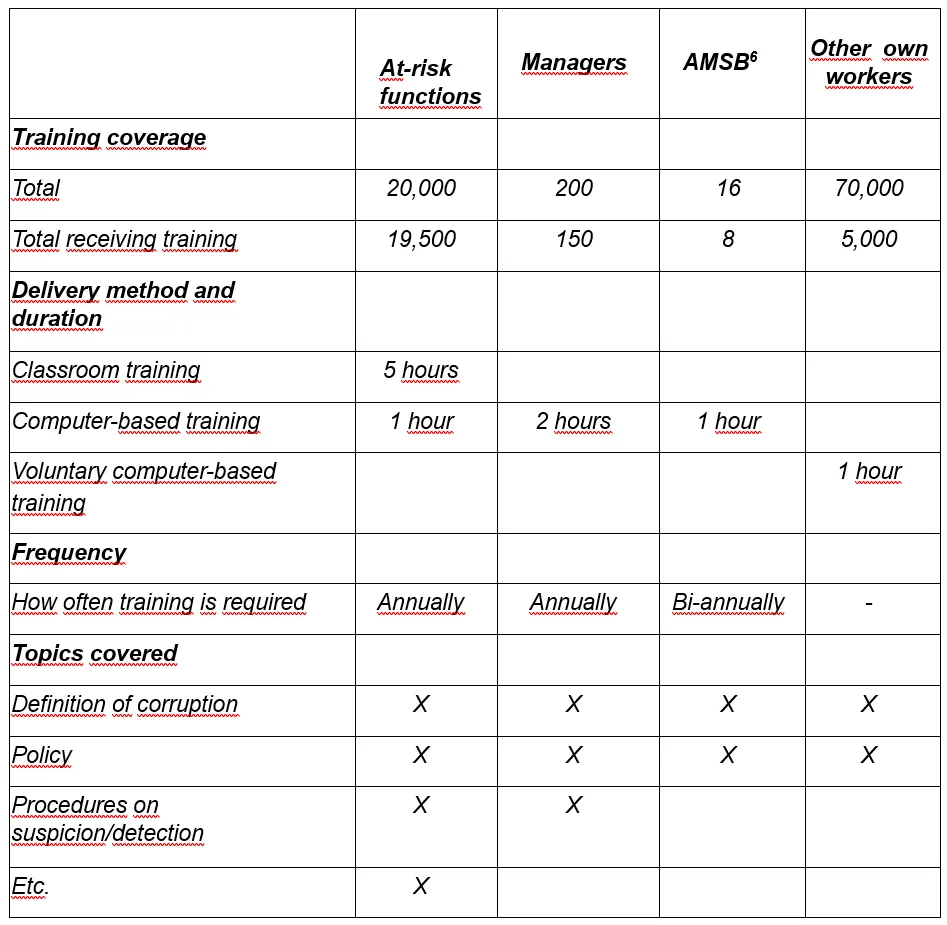
AR 8. The undertaking may present the required information about training using the following table:
Anti-corruption and bribery training illustrative example
During the 20XY financial year ABC provided training to its at-risk own workers in terms of its policy (see note x). For those at-risk functions the training is mandatory, but ABC also made available voluntary training for other own workers. Details of its training during the year is as follows: