E1-5 – Energy consumption and mix
🗂️ ESRS E1 Climate Change, page 8-10
-
The undertaking shall provide information on its energy consumption and mix.
-
The objective of this Disclosure Requirement is to provide an understanding of the undertaking’s total energy consumption in absolute value, improvement in energy efficiency, exposure to coal, oil and gas-related activities, and the share of renewable energy in its overall energy mix.
-
The disclosure required by paragraph 35 shall include the total energy consumption in MWh related to own operations disaggregated by:
(a) total energy consumption from fossil sources;
(b) total energy consumption from nuclear sources;
(c) total energy consumption from renewable sources disaggregated by:
i. fuel consumption for renewable sources including biomass (also comprising industrial and municipal waste of biologic origin), biofuels, biogas, hydrogen from renewable sources, etc.;
ii. consumption of purchased or acquired electricity, heat, steam, and cooling from renewable sources; and
iii. consumption of self-generated non-fuel renewable energy.
- The undertaking with operations in high climate impact sectors shall further disaggregate their total energy consumption from fossil sources by:
(a) fuel consumption from coal and coal products;
(b) fuel consumption from crude oil and petroleum products;
(c) fuel consumption from natural gas;
(d) fuel consumption from other fossil sources;
(e) consumption of purchased or acquired electricity, heat, steam, or cooling from fossil sources;
- In addition, where applicable, the undertaking shall disaggregate and disclose separately its non-renewable energy production and renewable energy production in MWh.
Energy intensity based on net revenue.
-
The undertaking shall provide information on the energy intensity (total energy consumption per net revenue) associated with activities in high climate impact sectors.
-
The disclosure on energy intensity required by paragraph 40 shall only be derived from the total energy consumption and net revenue from activities in high climate impact sectors.
-
The undertaking shall specify the high climate impact sectors that are used to determine the energy intensity required by paragraph 40.
-
The undertaking shall disclose the reconciliation to the relevant line item or notes in the financial statements of the net revenue amount from activities in high climate impact sectors (the denominator in the calculation of the energy intensity required by paragraph 40).
Application Requirements
Section titled “Application Requirements”Calculation guidance
AR 32. When preparing the information on energy consumption required under paragraph 35, the undertaking shall:
(a) only report energy consumed from processes owned or controlled by the undertaking applying the same perimeter applied for reporting GHG Scopes 1 and 2 emissions;
(b) exclude feedstocks and fuels that are not combusted for energy purposes. The undertaking that consumes fuel as feedstocks can disclose information on this consumption separately from the required disclosures;
(c) ensure all quantitative energy-related information is reported in either Mega-Watt- hours (MWh) in Lower Heating Value or net calorific value. If raw data of energy- related information is only available in energy units other than MWh (such as GigaJoules (GJ) or eritish Thermal Units (etu)), in volume units (such as cubic feet or gallons) or in mass units (such as kilograms or pounds), they shall be converted to MWh using suitable conversion factors (see for example Annex II of the Fifth Assessment IPCC report). Conversion factors for fuels shall be made transparent and applied in a consistent manner;
(d) ensure all quantitative energy-related information is reported as final energy consumption, referring to the amount of energy the undertaking actually consumes using for example the table in Annex IV of Directive 2012/27 of the European Parliament and of the Council17 on energy efficiency;
(e) avoid double counting fuel consumption when disclosing self-generated energy consumption. If the undertaking generates electricity from either a non-renewable or renewable fuel source and then consumes the generated electricity, the energy consumption shall be counted only once under fuel consumption;
(f) not offset energy consumption even if onsite generated energy is sold to and used by a third party;
(g) not count energy that is sourced from within the organisational boundary under “purchased or acquired” energy;
(h) account for steam, heat or cooling received as “waste energy” from a third party’s industrial processes under “purchased or acquired” energy;
(i) account for renewable hydrogen56 as a renewable fuel. Hydrogen that is not completely derived from renewable sources shall be included under “fuel consumption from other non-renewable sources”; and
(j) adopt a conservative approach when splitting the electricity, steam, heat or cooling between renewable and non-renewable sources based on the approach applied to calculate market-based Scope 2 GHG emissions. The undertaking shall only consider these energy consumptions as deriving from renewable sources if the origin of the purchased energy is clearly defined in the contractual arrangements with its suppliers (renewable power purchasing agreement, standardised green electricity tariff, market instruments like Guarantee of Origin from renewable sources in Europe or similar instruments like Renewable Energy Certificates in the US and Canada, etc.).
AR 33. The information required under paragraph 37 (a) is applicable if the undertaking is operating in at least one high climate impact sector. The information required under paragraph 38 (a) to (e). shall also include energy from fossil sources consumed in operations that are not in high climate impact sectors.
AR 34. The information on Energy consumption and mix may be presented using the following tabular format for high climate impact sectors and for all other sector by omitting rows (1) to (5).
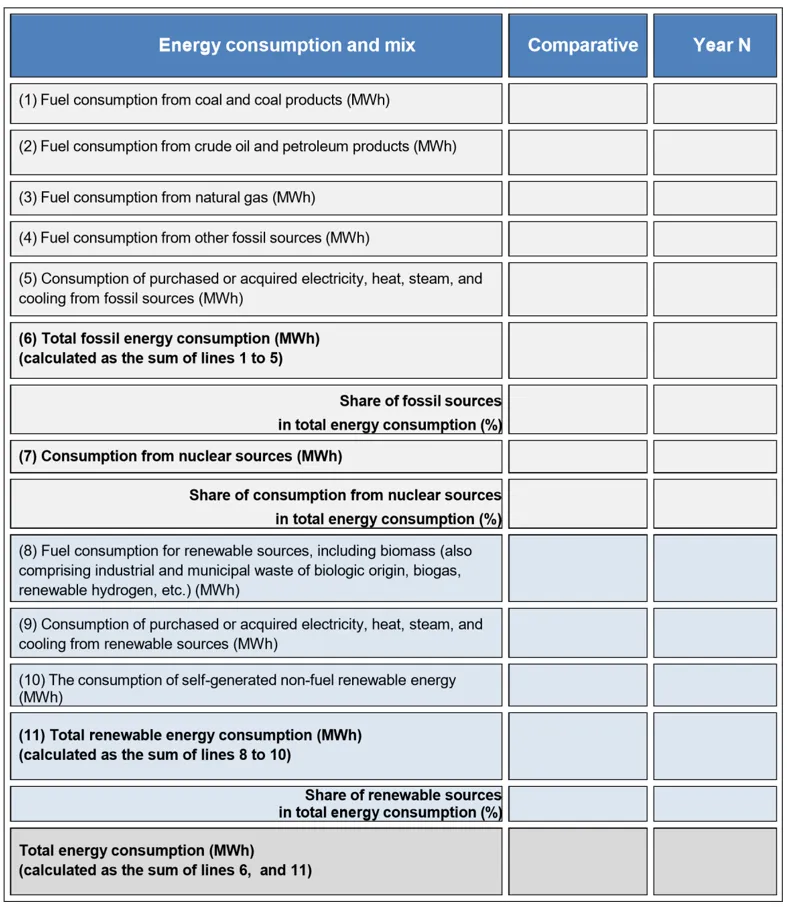
AR 35. The total energy consumption with a distinction between fossil, nuclear and renewable energy consumption may be presented graphically in the sustainability statement showing developments over time (e.g., through a pie or bar chart).
Energy intensity based on net revenue
Calculation guidance
AR 36. When preparing the information on energy intensity required under paragraph 40, the undertaking shall:
(a) calculate the energy intensity ratio using the following formula:

(b) express the total energy consumption in MWh and the net revenue in monetary units (e.g., Euros); (c) the numerator and denominator shall only consist of the proportion of the total final energy consumption (in the numerator) and net revenue (in the denominator) that are attributable to activities in high climate impact sectors. In effect, there should be consistency in the scope of both the numerator and denominator;
(d) calculate the total energy consumption in line with the requirement in paragraph 37;
(e) calculate the net revenue in line with the accounting standards requirements applicable for the financial statements, i.e., IFRS 15 Revenue from Contracts with Customers or local GAAP requirements.
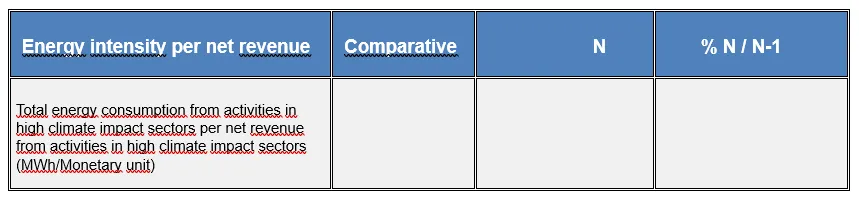
AR 37. The quantitative information may be presented in the following table.
Connectivity of energy intensity based on net revenue with financial reporting information
AR 38. The reconciliation of net revenue from activities in high climate impact sectors to the relevant financial statements line item or disclosure (as required by paragraph 43) may be presented either:
(a) by a cross-reference to the related line item or disclosure in the financial statements; or
(b) If the net revenue cannot be directly cross-referenced to a line item or disclosure in the financial statements, by a quantitative reconciliation using the below tabular format.
