E1-6 – Gross Scopes 1, 2, 3 and Total GHG emissions
🗂️ ESRS E1 Climate Change, page 10-12
- The undertaking shall disclose in metric tonnes of CO2eq its:
(a) gross Scope 1 GHG emissions;
(b) gross Scope 2 GHG emissions; (c) gross Scope 3 GHG emissions; and (d) total GHG emissions.
- The objective of the Disclosure Requirement in paragraph 44 in respect of:
(a) gross Scope 1 GHG emissions as required by paragraph 44 (a) is to provide an understanding of the direct impacts of the undertaking on climate change and the proportion of its total GHG emissions that are regulated under emission trading schemes.
(b) gross Scope 2 GHG emissions as required by paragraph 44 (b) is to provide an understanding of the indirect impacts on climate change caused by the undertaking’s consumed energy whether externally purchased or acquired.
(c) gross Scope 3 GHG emissions as required by paragraph 44 (c) is to provide an understanding of the GHG emissions that occur in the undertaking’s upstream and downstream value chain beyond its Scope 1 and 2 GHG emissions. For many undertakings, Scope 3 GHG emissions may be the main component of their GHG inventory and are an important driver of the undertaking’s transition risks.
(d) total GHG emissions as required by paragraph 44 (d) is to provide an overall understanding of the undertaking’s GHG emissions and whether they occur from its own operations or the upstream and downstream value chain. This disclosure is a prerequisite for measuring progress towards reducing GHG emissions in accordance with the undertaking’s climate-related targets and EU policy goals.
The information from this Disclosure Requirement is also needed to understand the undertaking’s climate-related transition risks.
-
When disclosing the information on GHG emissions required under paragraph 44, the undertaking shall refer to ESRS 1 paragraphs from 62 to 67. In principle, the data on GHG emissions of its associates or joint ventures that are part of the undertaking’s upstream and downstream value chain (ESRS 1 Paragraph 67) are not limited to the share of equity held. For its associates, joint ventures, unconsolidated subsidiaries (investment entities) and contractual arrangements that are joint arrangements not structured through an entity (i.e., jointly controlled operations and assets), the undertaking shall include the GHG emissions in accordance with the extent of the undertaking’s operational control over them.
-
In case of significant changes in the definition of what constitutes the reporting undertaking and its upstream and downstream value chain, the undertaking shall disclose these changes and explain their effect on the year-to-year comparability of its reported GHG emissions (i.e., the effect on the comparability of current versus previous reporting period GHG emissions).
-
The disclosure on gross Scope 1 GHG emissions required by paragraph 44 (a) shall include:
(a) the gross Scope 1 GHG emissions in metric tonnes of CO2eq; and
(b) the percentage of Scope 1 GHG emissions from regulated emission trading schemes.
-
The disclosure on gross Scope 2 GHG emissions required by paragraph 44 (b) shall include: (a) the gross location-based Scope 2 GHG emissions in metric tonnes of CO2eq; and (b) the gross market-based Scope 2 GHG emissions in metric tonnes of CO2eq.
-
For Scope 1 and Scope 2 emissions disclosed as required by paragraphs 44 (a) and (b) the undertaking shall disaggregate the information, separately disclosing emissions from:
(a) the consolidated accounting group (the parent and subsidiaries); and
(b) investees such as associates, joint ventures, or unconsolidated subsidiaries that are not fully consolidated in the financial statements of the consolidated accounting group, as well as contractual arrangements that are joint arrangements not structured through an entity (i.e., jointly controlled operations and assets), for which it has operational control.
-
The disclosure of gross Scope 3 GHG emissions required by paragraph 44 (c) shall include GHG emissions in metric tonnes of CO2eq from each significant Scope 3 category (i.e. each Scope 3 category that is a priority for the undertaking) .
-
The disclosure of total GHG emissions required by paragraph 44 (d) shall be the sum of Scope 1, 2 and 3 GHG emissions required by paragraphs 44 (a) to (c). The total GHG emissions shall be disclosed with a disaggregation that makes a distinction of:
(a) the total GHG emissions derived from the underlying Scope 2 GHG emissions being measured using the location-based method; and
(b) the total GHG emissions derived from the underlying Scope 2 GHG emissions being measured using the market-based method.
GHG Intensity based on net revenue
-
The undertaking shall disclose its GHG emissions intensity (total GHG emissions per net revenue).
-
The disclosure on GHG intensity required by paragraph 53 shall provide the total GHG emissions in metric tonnes of CO2eq (required by paragraph 44 (d)) per net revenue.
-
The undertaking shall disclose the reconciliation to the relevant line item or notes in the financial statements of the net revenue amounts (the denominator in the calculation of the GHG emissions intensity required by paragraph 53).
Application Requirements
Section titled “Application Requirements”Calculation guidance
AR 39. When preparing the information for reporting GHG emissions as required by paragraph 44, the undertaking shall:
(a) consider the principles, requirements and guidance provided by the GHG Protocol Corporate Standard (version 2004). The undertaking may consider Commission Recommendation (EU) 2021/2279 or the requirements stipulated by EN ISO 14064-1:2018. If the undertaking already applies the GHG accounting methodology of ISO 14064- 1: 2018, it shall nevertheless comply with the requirements of this standard (e.g., regarding reporting boundaries and the disclosure of market-based Scope 2 GHG emissions);
(b) disclose the methodologies, significant assumptions and emissions factors used to calculate or measure GHG emissions accompanied by the reasons why they were chosen, and provide a reference or link to any calculation tools used;
(c) include emissions of CO2, CH4, N2O, HFCs, PFCs, SF6, and NF3. Additional GHG may be considered when significant; and
(d) use the most recent Global Warming Potential (GWP) values published by the IPCC based on a 100-year time horizon to calculate CO2eq emissions of non-CO2 gases.
AR 40. When preparing the information for reporting GHG emissions from its associates, joint ventures, unconsolidated subsidiaries (investment entities) and contractual arrangements as required by paragraph 50, the undertaking shall consolidate 100% of the GHG emissions of the entities it operationally controls. In practice, this happens when the undertakings holds the license - or permit - to operate the assets from these associates, joint ventures, unconsolidated subsidiaries (investment entities) and contractual arrangements. When the undertaking has a contractually defined part-time operational control, it shall consolidate 100% the GHG emitted during the time of its operational control.
AR 41. In line with ESRS 1 chapter 3.7, the undertaking shall disaggregate information on its GHG emissions as appropriate. For example, the undertaking may disaggregate its Scope 1, 2, 3, or total GHG emissions by country, operating segments, economic activity, subsidiary, GHG category (CO2, CH4, N2O, HFCs, PFCs, SF6, NF3, and other GHG considered by the undertaking) or source type (stationary combustion, mobile combustion, process emissions and fugitive emissions).
AR 42. An undertaking might have a different reporting period from some or all of the entities in its value chain. In such circumstances, the undertaking is permitted to measure its GHG emissions in accordance with paragraph 44 using information for reporting periods that are different from its own reporting period if that information is obtained from entities in its value chain with reporting periods that are different from the undertaking’s reporting period, on the condition that:
(a) the undertaking uses the most recent data available from those entities in its value chain to measure and disclose its greenhouse gas emissions;
(b) the length of the reporting periods is the same; and
(c) the undertaking discloses the effects of significant events and changes in circumstances (relevant to its GHG emissions) that occur between the reporting dates of the entities in its value chain and the date of the undertaking’s general purpose financial statements.
AR 43. When preparing the information on gross Scope 1 GHG emissions required under paragraph 48 (a), the undertaking shall:
(a) calculate or measure GHG emissions from stationary combustion, mobile combustion, process emissions and fugitive emissions; and use suitable activity data that include the non-renewable fuel consumption;
(b) use suitable and consistent emission factors;
(c) disclose biogenic emissions of CO2 from the combustion or bio-degradation of biomass separately from the Scope 1 GHG emissions, but include emissions of other types of GHG (in particular CH4 and N2O);
(d) not include any removals, or any purchased, sold or transferred carbon credits or GHG allowances in the calculation of Scope 1 GHG emissions; and
(e) for activities reporting under the EU ETS, report on Scope 1 emissions following the EU ETS methodology. The EU ETS methodology may also be applied to activities in geographies and sectors that are not covered by the EU ETS.
AR 44. When preparing the information on the percentage of Scope 1 GHG emissions from regulated emission trading schemes required under paragraph 48 (b), the undertaking shall:
(a) consider GHG emissions from the installations it operates that are subject to regulated Emission Trading Schemes (ETS), including the EU-ETS, national ETS and non-EU ETS, if applicable;
(b) only include emissions of CO2, CH4, N2O, HFCs, PFCs, SF6, and NF3;
(c) ensure the same accounting period for gross Scope 1 GHG emissions and GHG emissions regulated under the ETS; and
(d) calculate the share by using the following formula:
GHG Emissions in (t CO2eq) from EU ETS installations + national ETS installations + nonEU ETS installations + Scope 1 GHG emissions (t CO2eq)
AR 45. When preparing the information on gross Scope 2 GHG emissions required under paragraph 49, the undertaking shall:
(a) consider the principles and requirements of the GHG Protocol Scope 2 Guidance (version 2015, in particular the Scope 2 quality criteria in chapter 7.1 relating to contractual instruments); it may also consider Commission Recommendation (EU) 2021/2279 or the relevant requirements for the quantification of indirect GHG emissions from imported energy in EN ISO 14064-1:2018;
(b) include purchased or acquired electricity, steam, heat, and cooling consumed by the undertaking;
(c) avoid double counting of GHG emissions reported under Scope 1 or 3;
(d) apply the location-based and market-based methods to calculate Scope 2 GHG emissions and provide information on the share and types of contractual instruments. Locationbased method quantifies Scope 2 GHG emissions based on average energy generation emission factors for defined locations, including local, subnational, or national boundaries (GHG Protocol, “Scope 2 Guidance”, Glossary, 2015). Market-based method quantifies Scope 2 GHG emissions based on GHG emissions emitted by the generators from which the reporting entity contractually purchases electricity bundled with instruments, or unbundled instruments on their own (GHG Protocol, “Scope 2 Guidance”, Glossary, 2015); in this case, the undertaking may disclose the share of market-based scope 2 GHG emissions linked to purchased electricity bundled with instruments such as Guarantee of Origins or Renewable Energy Certificates. The undertaking shall provide information about the share and types of contractual instruments used for the sale and purchase of energy bundled with attributes about the energy generation or for unbundled energy attribute claims.
(e) disclose biogenic emissions of CO2 carbon from the combustion or biodegradation of biomass separately from the Scope 2 GHG emissions but include emissions of other types of GHG (in particular CH4 and N2O). In case the emission factors applied do not separate the percentage of biomass or biogenic CO2, the undertaking shall disclose this. In case GHG emissions other than CO2 (particularly CH4 and N2O) are not available for, or excluded from, location-based grid average emissions factors or with the market-based method information, the undertaking shall disclose this.
(f) not include any removals, or any purchased, sold or transferred carbon credits or GHG allowances in the calculation of Scope 2 GHG emissions.
AR 46. When preparing the information on gross Scope 3 GHG emissions required under paragraph 51, the undertaking shall:
(a) consider the principles and provisions of the GHG Protocol Corporate Value Chain (Scope 3) Accounting and Reporting Standard (Version 2011); and it may consider Commission Recommendation (EU) 2021/2279 or the relevant requirements for the quantification of indirect GHG emissions from EN ISO 14064-1:2018;
(b) if it is a financial institution, consider the GHG Accounting and Reporting Standard for the Financial Industry from the Partnership for Carbon Accounting Financial (PCAF), specifically part A “Financed Emissions” (version December 2022);
(c) screen its total Scope 3 GHG emissions based on the 15 Scope 3 categories identified by the GHG Protocol Corporate Standard and GHG Protocol Corporate Value Chain (Scope 3) Accounting and Reporting Standard (Version 2011) using appropriate estimates. Alternatively, it may screen its indirect GHG emissions based on the categories provided by EN ISO 14064-1:2018 clause 5.2.4 (excluding indirect GHG emissions from imported energy);
(d) identify and disclose its significant Scope 3 categories based on the magnitude of their estimated GHG emissions and other criteria provided by GHG Protocol Corporate Value Chain (Scope 3) Accounting and Reporting Standard (Version 2011, p. 61 and 65-68) or EN ISO 14064-1:2018 Annex H.3.2, such as financial spend, influence, related transition risks and opportunities or stakeholder views;
(e) calculate or estimate GHG emissions in significant Scope 3 categories using suitable emissions factors;
(f) update Scope 3 GHG emissions in each significant category every year on the basis of current activity data; update the full Scope 3 GHG inventory at least every 3 years or on the occurrence of a significant event or a significant change in circumstances (a significant event or significant change in circumstances can, for example, relate to changes in the undertaking’s activities or structure, changes in the activities or structure of its upstream and downstream value chain(s), a change in calculation methodology or in the discovery of errors);”);
(g) disclose the extent to which the undertaking’s Scope 3 GHG emissions are measured using inputs from specific activities within the entity’s upstream and downstream value chain, and disclose the percentage of emissions calculated using primary data obtained from suppliers or other value chain partners.
(h) for each significant Scope 3 GHG category, disclose the reporting boundaries considered, the calculation methods for estimating the GHG emissions as well as if and which calculation tools were applied. The Scope 3 categories should be consistent with the GHGP and include:
i. indirect Scope 3 GHG emissions from the consolidated accounting group (the parent and its subsidiaries),
ii. indirect Scope 3 GHG emissions from associates, joint ventures, and unconsolidated subsidiaries for which the undertaking has the ability to control the operational activities and relationships (i.e., operational control),
iii. Scope 1, 2 and 3 GHG emissions from associates, joint ventures, unconsolidated subsidiaries (investment entities) and joint arrangements for which the undertaking does not have operational control and when these entities are part of the undertaking’s upstream and dopwnstream value chain.
(i) disclose a list of Scope 3 GHG emissions categories included in and excluded from the inventory with a justification for excluded Scope 3 categories;
(j) disclose biogenic emissions of CO2 from the combustion or biodegradation of biomass that occur in its upstream and downstream value chain separately from the gross Scope 3 GHG emissions, and include emissions of other types of GHG (such as CH4 and N2O), and emissions of CO2 that occur in the life cycle of biomass other than from combustion or biodegradation (such as GHG emissions from processing or transporting biomass) in the calculation of Scope 3 GHG emissions;
(k) not include any removals, or any purchased, sold or transferred carbon credits or GHG allowances in the calculation of Scope 3 GHG emissions;
AR 47. When preparing the information on the total GHG emissions required under paragraph 52, the undertaking shall:
(a) apply the following formulas to calculate the total GHG emissions:
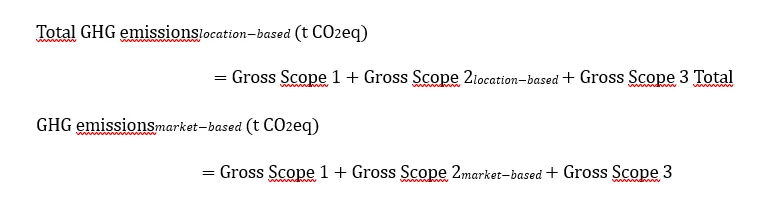
(b) disclose total GHG emissions with a distinction between emissions derived from the location-based and market-based methods applied while measuring the underlying Scope 2 GHG emissions.
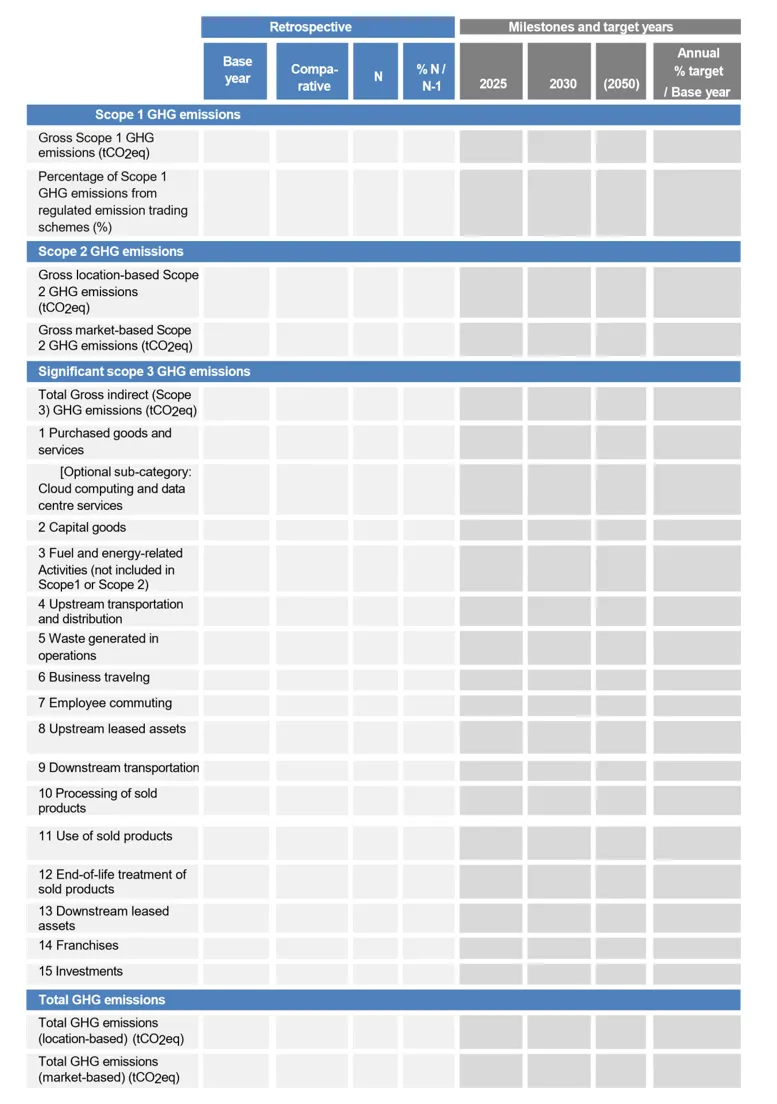
AR 48. The undertaking shall disclose its total GHG emissions disaggregated by Scopes 1 and 2 and significant Scope 3 in accordance with the table below.
AR 49. To highlight potential transition risks, the undertaking may disclose its total GHG emissions disaggregated by major countries and, if applicable, by operating segments (applying the same segments for the financial statements as required by the accounting standards, i.e., IFRS 8
Operating Segments or local GAAP). Scope 3 GHG emissions may be excluded from these breakdowns by country if the related data is not readily available.
AR 50. The Scope 3 GHG emissions may also be presented by according to the indirect emission categories defined in EN ISO 14064-1:2018.
AR 51. If it is material for the undertaking’s Scope 3 emissions, it shall disclose the GHG emissions from purchased cloud computing and data centre services as a subset of the overarching Scope 3 category “upstream purchased goods and services”.
AR 52. The total GHG emissions disaggregated by Scope 1, 2 and 3 GHG emissions may be graphically presented in the sustainability statement (e.g., as a bar or pie chart) showing the split of GHG emissions across the value chain (Upstream, Own operations, Transport, Downstream).
GHG intensity based on net revenue
Calculation guidance
AR 53. When disclosing the information on GHG intensity based on net revenue required under paragraph 53, the undertaking shall:
(a) calculate the GHG intensity ratio by the following formula:
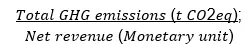
(b) express the total GHG emissions in metric tonnes of CO2eq and the net revenue in monetary units (e.g., Euros) and present the results for the market-based and locationbased method;
(c) include the total GHG emissions in the numerator and overall net revenue in the denominator;
(d) calculate the total GHG emissions as required by paragraphs 44 (d) and 52; and
(e) calculate the net revenue in line with the requirements in accounting standards applied for financial statements, i.e., IFRS 15 or local GAAP.
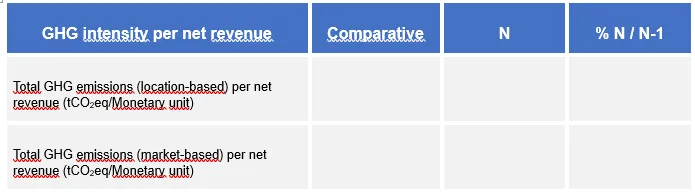
AR 54. The quantitative information may be presented in the following tabular format.
Connectivity of GHG intensity based on revenue with financial reporting information
AR 55. The reconciliation of the net revenue used to calculate GHG intensity to the relevant line item or notes in the financial statements (as required by paragraph 55) may be done by either:
(a) a cross-reference to the related line item or disclosure in the financial statements; or
(b) if the net revenue cannot be directly cross-referenced to a line item or disclosure in the financial statements, by a quantitative reconciliation using the below tabular format.
