IRO-1 -Description of processes to identify and assess material biodiversity and ecosystem-related impacts,risks,dependencies and opportunities
🗂️ ESRS E4 Biodiversity and Ecosystems, page 5-6
- The undertaking shall describe its process to identify material impacts, risks, dependencies and opportunities. The description of the process shall include whether and how the undertaking:
(a) identified and assessed actual and potential impacts on biodiversity and ecosystems at own site locations and in the upstream and downstream value chain, including assessment criteria applied;
(b) identified and assessed dependencies on biodiversity and ecosystems and their services at own site locations and in the upstream and downstream value chain, including assessment criteria applied, and, if this assessment includes ecosystem services that are disrupted or likely to be;
(c) identified and assessed transition and physical risks and opportunities related to biodiversity and ecosystems, including assessment criteria applied based on its impacts and dependencies;
(d) considered systemic risks;
(e) conducted consultations with affected communities on sustainability assessments of shared biological resources and ecosystems and, in particular:
i. when a site, a raw material production or sourcing is likely to negatively impact biodiversity and ecosystems, the identification of the specific sites, raw materials production or sourcing with negative or potentially negative impacts on affected communities;
ii. when affected communities are likely to be impacted, the undertaking, shall disclose how these communities were involved in the materiality assessment; and
iii. with respect to impacts on ecosystem services of relevance to affected communities in its own operations, the undertaking shall indicate how negative impacts may be avoided. If these impacts are unavoidable, the undertaking may indicate its plans to minimise them and implement mitigation measures that aim to maintain the value and functionality of priority services.
- The undertaking may disclose whether and how it has used biodiversity and ecosystems scenario analysis to inform the identification and assessment of material risks and opportunities over short-, medium- and long-term time horizons. If the undertaking has used such scenario analysis, it may disclose the following information:
(a) why the considered scenarios were selected;
(b) how the considered scenarios are updated according to evolving conditions and emerging trends; and
(c) whether the scenarios are informed by expectations published by authoritative intergovernmental bodies, such as the Convention for Biological Diversity and, where relevant, by scientific consensus, such as that expressed by the Intergovernmental Science-policy Platform on Biodiversity and Ecosystem Services (IPBES).
- The undertaking shall specifically disclose:
(a) whether or not it has sites located in or near biodiversity-sensitive areas and whether activities related to these sites negatively affect these areas by leading to the deterioration of natural habitats and the habitats of species and to the disturbance of the species for which a protected area has been designated; and
(b) whether it has been concluded that it is necessary to implement biodiversity mitigation measures, such as those identified in: Directive 2009/147/EC of the European Parliament and of the Council on the conservation of wild birds; Council Directive 92/43/EEC on the conservation of natural habitats and of wild fauna and flora; an Environmental Impact Assessment (EIA) as defined in Article 1(2), point (g), of Directive 2011/92/EU of the European Parliament and of the Council on the assessment of the effects of certain public and private projects on the environment; and for activities located in third countries, in accordance with equivalent national provisions or international standards, such as the International Finance Corporation (IFC) Performance Standard 6: Biodiversity Conservation and Sustainable Management of Living Natural Resources.
Application Requirements
Section titled “Application Requirements”AR 4. The materiality assessment under ESRS E4 includes the undertaking’s:
(a) contribution to direct impact drivers on biodiversity loss:
i. climate change;
ii. land-use change (e.g., land artificialisation), freshwater-use change and sea- use change;
iii. direct exploitation;
iv. invasive alien species;
v. pollution; and vi. vi. others.
(b) impacts on the state of species (i.e., species population size, species global extinction risk);
(c) impacts on the extent and condition of ecosystems including through land degradation, desertification and soil sealing); and
(d) impacts and dependencies on ecosystem services.
AR 5. When assessing the materiality of impacts, dependencies, risks and opportunities the undertaking shall consider the provisions in ESRS 2 IRO-1 and ESRS 1 Chapter 3 Double materiality as the basis for sustainability disclosures and describe its considerations.
AR 6. The undertaking shall assess the materiality of biodiversity and ecosystems in its own operations and its upstream and downstream value chain, and may conduct its materiality assessment in line with the first three phases of the LEAP approach: Locate (paragraph AR 7), Evaluate (paragraph AR 8) and Assess (paragraph AR 9).
AR 7. Phase 1 relates to the localisation of relevant sites regarding its interface with biodiversity and ecosystems. To identify these relevant sites the undertaking may:
(a) develop a list of locations of direct assets and operations and related upstream and downstream value chain that are relevant to the undertakings business activities. Furthermore, the undertaking may provide information about sites for which future operations have been formally announced;
(b) list the biomes and ecosystems it is interfacing with based on the list of locations identified under paragraph AR 7(a);
(c) identify the current integrity and importance of biodiversity and ecosystem at each location taking into consideration the information provided in paragraphs 16 and 17;
(d) develop a list of locations where the undertaking is interfacing with locations in or near biodiversity-sensitive areas taking into consideration the information provided in paragraphs 16 and 17; and
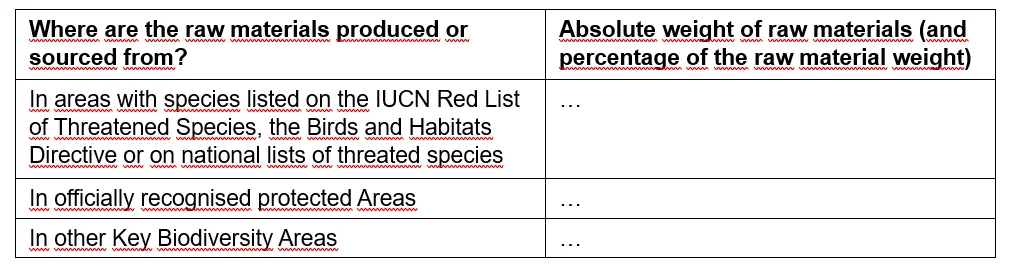
(e) identify which sectors, business units, value chains or asset classes are interfacing with biodiversity and ecosystems in these material sites. Instead of identifying these interfaces per site, the undertaking may choose to identify them per raw material procured or sold by weight in tons, if such practice offers greater transparency.
AR 8. In Phase 2, to evaluate its actual or potential impacts and dependencies on biodiversity and ecosystems for relevant sites, the undertaking may:
(a) identify business processes and activities that interface with biodiversity and ecosystems;
(b) identify actual and potential impacts and dependencies;
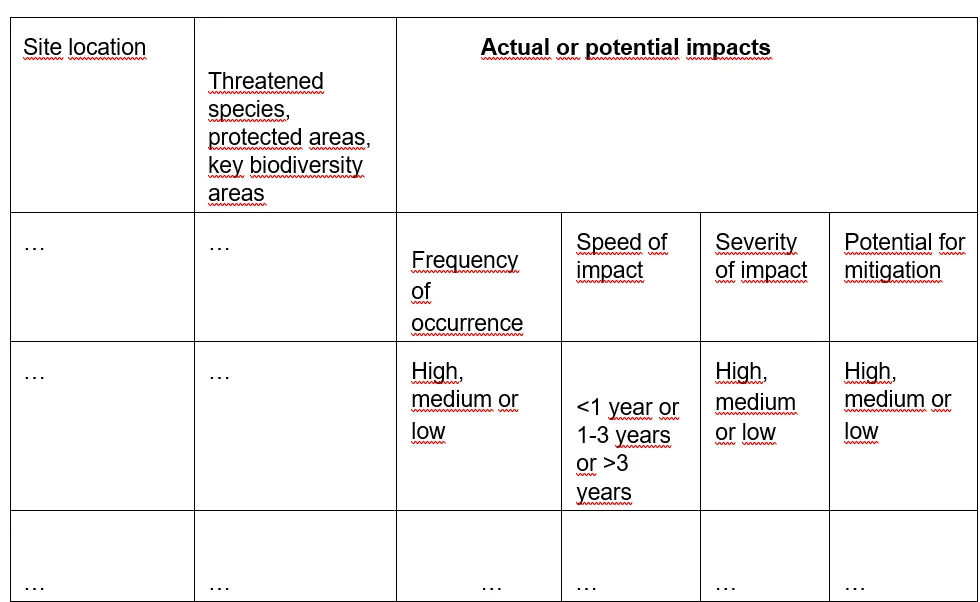
(c) indicate the size, scale, frequency of occurrence and timeframe of the impacts on biodiversity and ecosystems taking into consideration the disclosures under paragraphs 16 and 17. Furthermore, the undertaking may disclose:
i. the percentage of its suppliers’ facilities which are located in risk prone areas (with threatened species on the IUCN Red List of Species, the Birds and Habitats Directive or nationally list of threatened species, or in officially recognised Protected Areas, the Natura 2000 network of protected areas and Key Biodiversity Areas);
ii. the percentage of its procurement spend from suppliers with facilities which are located in risk prone areas (with threatened species on the IUCN Red List of Species, the Birds and Habitats Directive or nationally list of threatened species, or in officially recognised Protected Areas, the Natura 2000 network of protected areas and Key Biodiversity Areas); and
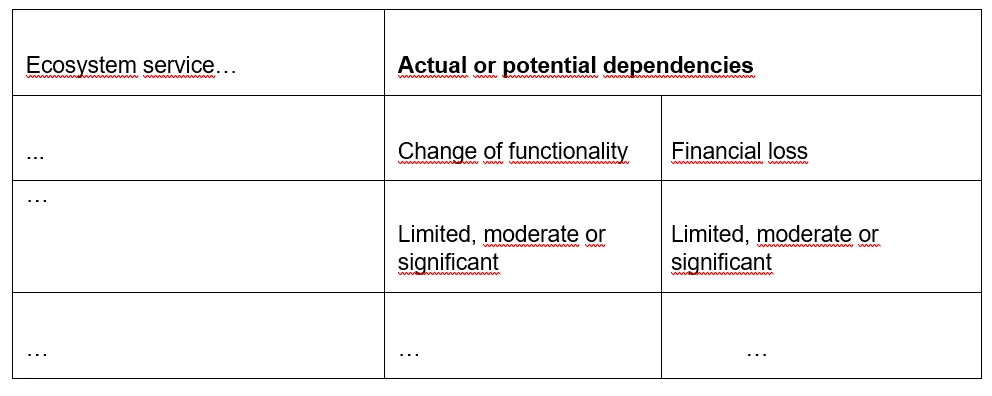
(d) indicate the size and scale of the dependencies on biodiversity and ecosystems, including on raw materials, natural resources and ecosystem services. The undertaking may rely on the international classifications such as the Common International Classification of Ecosystem Services (CICES).
AR 9. In Phase 3, to assesses its material risks and opportunities based on the results of Phases 1 and 2, the undertaking may consider the following categories:
(a) physical risks:
i. acute risks (e.g., natural disasters exacerbated by loss of coastal protection from ecosystems, leading to costs of storm damage to coastal infrastructure, disease or pests affecting the species or variety of crop the undertaking relies on, especially in the case of no or low genetic diversity, species loss and ecosystem degradation); and
ii. chronic risks (e.g., loss of crop yield due to decline in pollination services, increasing scarcity or variable production of key natural inputs, ecosystem degradation due to operations leading to, for example, coastal erosion and forest fragmentation, ocean acidification, land loss to desertification and soil degradation and consequent loss of soil fertility, species loss).
(b) transition risks, including:
i. policy and legal: e.g. introduction of regulation or policy (e.g. changes such as increased land protection); exposure to sanctions and litigation (e.g. spills of polluting effluents that damage human and ecosystem health; or violation of biodiversity-related rights, permits or allocations; or negligence towards or killing of threatened species); enhanced reporting obligations on biodiversity, ecosystems and related services;
ii. technology: e.g. substitution of products or services by products or services with a lower impact on biodiversity or dependence on ecosystem services, lack of access to data or access to poor quality data that hamper biodiversity-related assessments, transition to more efficient and cleaner technologies (i.e. with lower impacts on biodiversity), new monitoring technologies (e.g. satellite), requirements to use certain technologies (e.g. climate resistant crops, mechanical pollinators, water purification, flood protection);
iii. market: e.g., shifting supply, demand and financing, volatility or increased costs of raw materials (e.g., biodiversity-intense inputs for which price has risen due to ecosystem degradation);
iv. reputation: e.g., changing societal, customer or community perceptions as a result of an organisation’s role in loss of biodiversity, violation of nature-related rights through operations, negative media coverage due to impacts on critical species and/or ecosystems, biodiversity-related social conflicts over endangered species, protected areas, resources or pollution.
(c) systemic risks, including:
i. ecosystem collapse risks that a critical natural system no longer functions, e.g., tipping points are reached and the collapse of ecosystems resulting in wholesale geographic or sector losses (summing physical risks);
ii. aggregated risk linked to fundamental impacts of biodiversity loss to levels of transition and physical risk across one or more sectors in a portfolio (corporate or financial); and
iii. contagion risks that financial difficulties of certain corporations or financial institutions linked to failure to account for exposure to biodiversity-related risks spill over to the economic system as a whole.
(d) opportunities, including for example:
i. business performance categories: resource efficiency; products and services; markets; capital flow and financing; reputational capital; and
ii. sustainability performance categories: ecosystem protection, restoration and regeneration; sustainability use of natural resources.
Presentation of information:
AR 10. The undertaking may consider the tables below to facilitate its materiality assessment of material sites identified under paragraph AR 7:
With regard to AR 7(e), the undertaking may consider using the table below: