B3 – Energy and greenhouse gas emissions
🗂️ VSME Basic Module – Environment metrics, page 9
- The undertaking shall disclose its total energy consumption in MWh, with a breakdown as per the table below, if it can obtain the necessary information to provide such a breakdown:
| Renewable | Non-renewable | Total | |
|---|---|---|---|
| Electricity (as reflected in utility billings) | |||
| Fuels | |||
| Total |
- The undertaking shall disclose its estimated gross greenhouse gas (GHG) emissions in tons of CO2 equivalent (tCO2eq) considering the content of the GHG Protocol Corporate Standard (version 2004), including:
(a) the Scope 1 GHG emissions in tCO2eq (from owned or controlled sources); and
(b) the location-based Scope 2 emissions in tCO2eq (i.e. emissions from the generation of purchased energy, such as electricity, heat, steam or cooling).
- The undertaking shall disclose its GHG intensity calculated by dividing ‘gross greenhouse gas (GHG) emissions’ disclosed under paragraph 30 by ‘turnover (in Euro)’ disclosed under paragraph 24(e)(iv) [5] .
🗂️ VSME Comprehensive Module - Environmental Metrics, page 12-13
Consideration when reporting on GHG emissions under B3 (Basic Module)
-
Depending on the type of activities carried out by the undertaking, disclosing a quantification of its Scope 3 GHG emissions can be appropriate (see paragraph 10 of this Standard) to yield relevant information on the undertaking’s value chain impacts on climate change.
-
Scope 3 emissions are indirect GHG emissions (other than Scope 2) that derive from an undertaking’s value chain. They include the activities that are upstream of the undertaking’s operations (e.g. purchased goods and services, purchased capital goods, transportation of purchased goods, etc.) and activities that are downstream of the undertaking’s operations (e.g. transport and distribution of the undertaking’s products, use of sold products, investments, etc.).
-
If the undertaking decides to provide this metric, it should refer to the 15 types of Scope 3 GHG emissions identified by the GHG Protocol Corporate Standard and detailed by the GHG Protocol Corporate Value Chain (Scope 3) Accounting and Reporting Standard. When it reports on Scope 3 GHG emissions, the undertaking shall include significant Scope 3 categories (as per the Corporate Value Chain (Scope 3) Accounting and Reporting Standard) based on its own assessment of relevant Scope 3 categories. Undertakings can find further guidance on specific calculation methods for each category in the GHG Protocol’s Technical guidance for Calculating Scope 3 Emissions.
-
When reporting its Scope 1 and Scope 2 emissions, if the undertaking discloses entity-specific information on its Scope 3 emissions, it shall present it together with the information required under B3 – Energy and greenhouse gas emissions.
🗂️ VSME Basic Module Guidance – Environmental Metrics, page 17-23
Impacts on climate: energy usage and greenhouse gas emissions
- Under paragraphs 29 and 30, the undertaking reports on its climate impacts, providing information about its energy use and greenhouse gas emissions. This guidance for disclosure B3 does not constitute an additional datapoint to the disclosures described in paragraphs 29 (on energy consumption) and 30 (on GHG emissions) but rather reinstates an overarching objective and provides context for the Basic disclosure B3.
Energy consumption
- Climate related impacts are significantly driven by energy consumption. Therefore, it is relevant to disclose both the quantity as well as the type – e.g. fossil fuels such as coal, oil and gas versus renewable energy – and mix of energy consumed. Examples of energy disclosures are total energy consumption broken down by fossil fuels and electricity. Other breakdowns may be reported such as consumption of purchased or self-generated electricity from renewable sources. An example of the information requested in paragraph 29 follows.
| Renewable Energy Consumption (MWh) | Non-renewable Energy Consumption (MWh) | Total 202(x) Energy consumption (MWh) | |
|---|---|---|---|
| Electricity (as reflected in utility billings) | 300 | 186 | 486 |
| Fuels | 3 | 7 | 10 |
| Total | 303 | 193 | 496 |
-
In case the undertaking purchases fossil fuels (e.g. natural gas, oil) or renewable fuels (e.g. biofuels, such as biodiesel and bioethanol) to generate electricity, heat or cooling for its own consumption, it has to avoid double counting. Therefore, the undertaking accounts for the energy content of the purchased fuel only as fuel consumption, but it does not account for, or report on, its electricity and heat consumption produced from that fuel yet again. In case of electricity generation from renewable energies such as solar or wind – and where no fuel use is necessary – the undertaking accounts for the amount of electricity generated and consumed as electricity consumption.
-
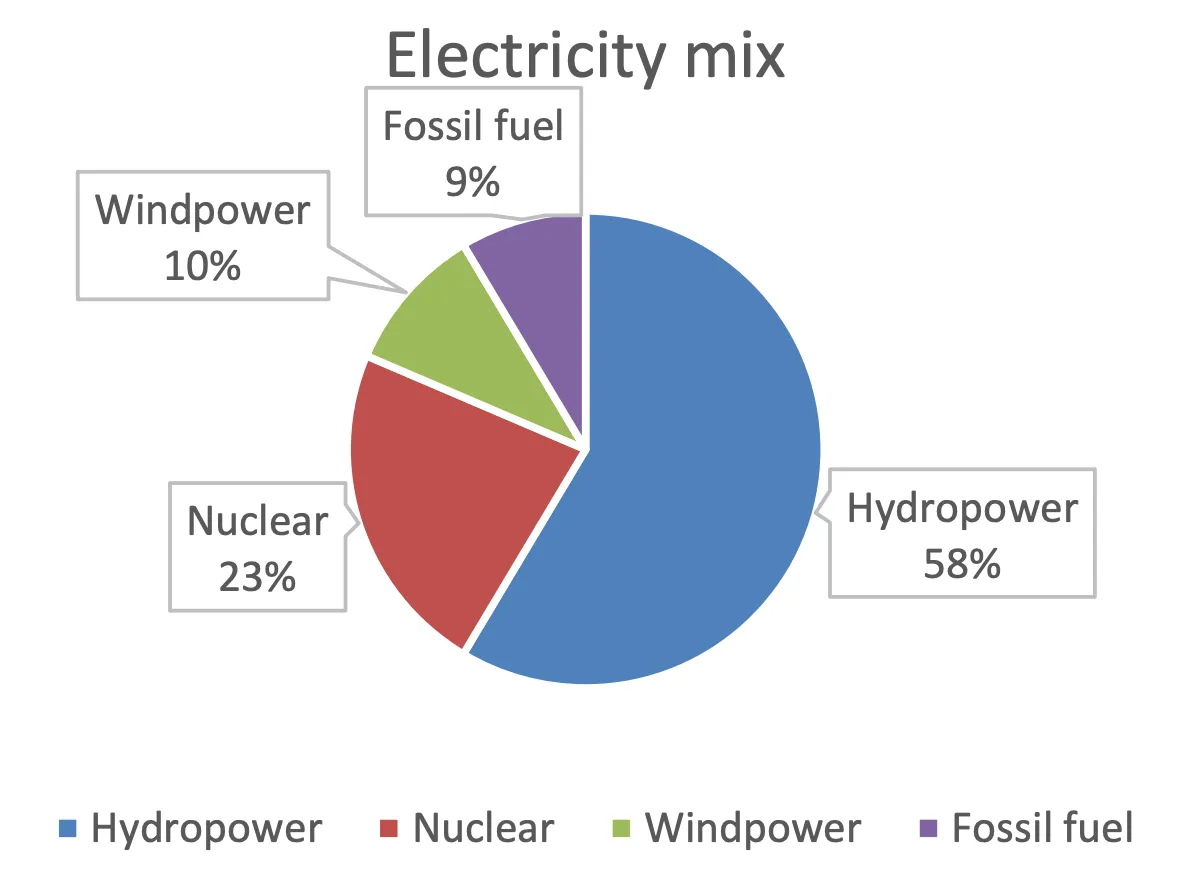
The undertaking shall not offset its energy consumption by its energy production even if on site generated energy is sold to and used by a third party. The undertaking shall also avoid double counting fuel consumption when disclosing self-generated energy consumption. If the undertaking generates electricity from either a non-renewable or renewable fuel source and then consumes the generated electricity, the energy consumption shall be counted only once under fuel consumption. The share of renewable energy consumption can be calculated based on guarantees of origin, renewable energy certificates or electricity composition as stated in the electricity bill. The electricity bill may refer to electricity units consumed and specify the percentage of electricity provided coming from renewable sources and it may look like the figure below.
- When preparing the information on energy consumption required under paragraph 29, the undertaking shall exclude feedstocks and fuels that are not combusted for energy purposes. The undertaking that consumes fuel as feedstocks can disclose information on this consumption separately from the required disclosures.
Conversion between different energy units
-
Undertakings are to report their energy consumption in terms of final energy, which is understood as the amount of energy delivered to the undertaking, for example, the Megawatt-Hours (MWh) of electricity purchased from the utility steam received from a nearby industrial plant or diesel purchased at petrol stations. Electricity explicitly refers to heat, steam and cooling. Fuels include anything burned, e.g. gas, natural gas, biomass, etc.
-
Paragraph 29 indicates MWh as the unit of choice for measuring energy consumption. In case of fuel or biomass, a conversion to MWh is necessary for data expressed in other units such as energy content (e.g. kJ, Btu), volume (e.g. litres, m³) or mass (e.g. metric tonnes, short tonnes).
-
For fuel consumption measured by mass (e.g. wood, coal), the undertaking should:
(a) obtain the Net Calorific Value (e.g. kJ/metric ton, TJ/Gg) of the fuel (it can be a typical value published by reliable sources, e.g. IPCC, or may be provided by the supplier or attained internally);
(b) convert the Net Calorific Value to MWh/ton, for example:
1 TJ = 10^12 J = 277.78 MWh ; 1 Gg = 109 g = 1,000 t
11.9 TJ/Gg = 11.9 * 277.78/1000 t = 3.31 MWh/ton; and
(c) calculate the energy content of the mass, for example:
*1,245,345 t ** 3.31 MWh/ton = 4,117,111 MWh.
- For liquid fuel, the undertakings should:
(a) convert volume information to mass, multiplying volume by fuel density, for example,
Diesel = 4,456,000 l; Diesel density = 0.84 kg/l
4,456,000 (l) * 0.84 (kg/l) = 3,43,040 kg = 3,743 t;
(b) calculate the energy content, multiplying mass by Net Calorific Value, for example, 3,743 [t] 43 [TJ/Gg] = 3,743 t 43 TJ/(1,000 [t]) = 160.95 [TJ] ; and
(c) convert TJ to MWh, for example 1 TJ = 10^12 J = 277.778 MWh
*160.95 [TJ] = 277.78 [MWh/TJ] ** 160.95 [TJ] = 44,708 MWh.
Documentation Source:
CDP Technical Note: Conversion of fuel data to MWh https://cdn.cdp.net/cdpproduction/cms/guidance_docs/pdfs/000/000/477/original/CDPConversion-of-fuel-data-to-MWh.pdf?1479755175
Greenhouse gas emissions
-
As for gross greenhouse gas emissions (GHG) arising from the undertaking’s activities, the requirement in paragraph 30 builds on the definitions and rules of the GHG Protocol, the leading accounting standard for GHG emissions. Under paragraph 30, undertakings are to report on their Scope 1 and Scope 2 emissions. Scope 1 GHG emissions cover direct emissions from owned or controlled sources. Scope 2 emissions are indirect GHG emissions resulting from the activities of the reporting company (as they derive from the undertaking’s consumed energy) which, however, occur at sources owned or controlled by another company. Further guidance is provided in the sections below on how to calculate Scope 1 and 2 emissions.
-
Scope 1 and 2 emissions may be reported in the following format.
| 202(x) GHG emissions (tCO2e) | |
|---|---|
| Scope 1 | 45 |
| Scope 2 | 6 |
| Total | 51 |
-
The GHG Protocol is a global standard for measuring, reporting and managing GHG emissions while ensuring consistency and transparency. The corporate standard covers Scope 1, Scope 2 and Scope 3 emissions guidance for companies and other organisations (NGOs, government, etc.).
-
To ensure a fair account of the undertaking’s emissions, the GHG Protocol has set a list of reporting principles:
(a) relevance: ensuring that the GHG inventory reflects the GHG emissions of the organisation.
(b) completeness: ensuring that the GHG inventory account for all GHG emission sources and activities within the chosen boundary;
(c) consistency: ensuring the consistency of the methodology used to allow for comparisons over time;
(d) transparency: disclosing the assumptions, references and methodology used when computing GHG emissions; and
(e) accuracy: ensuring that GHG emissions data is sufficiently precise to allow users to make decisions.
-
In alternative to the GHG Protocol, undertakings may resort to ISO 14064-1, should it be better suited to their reporting needs.
-
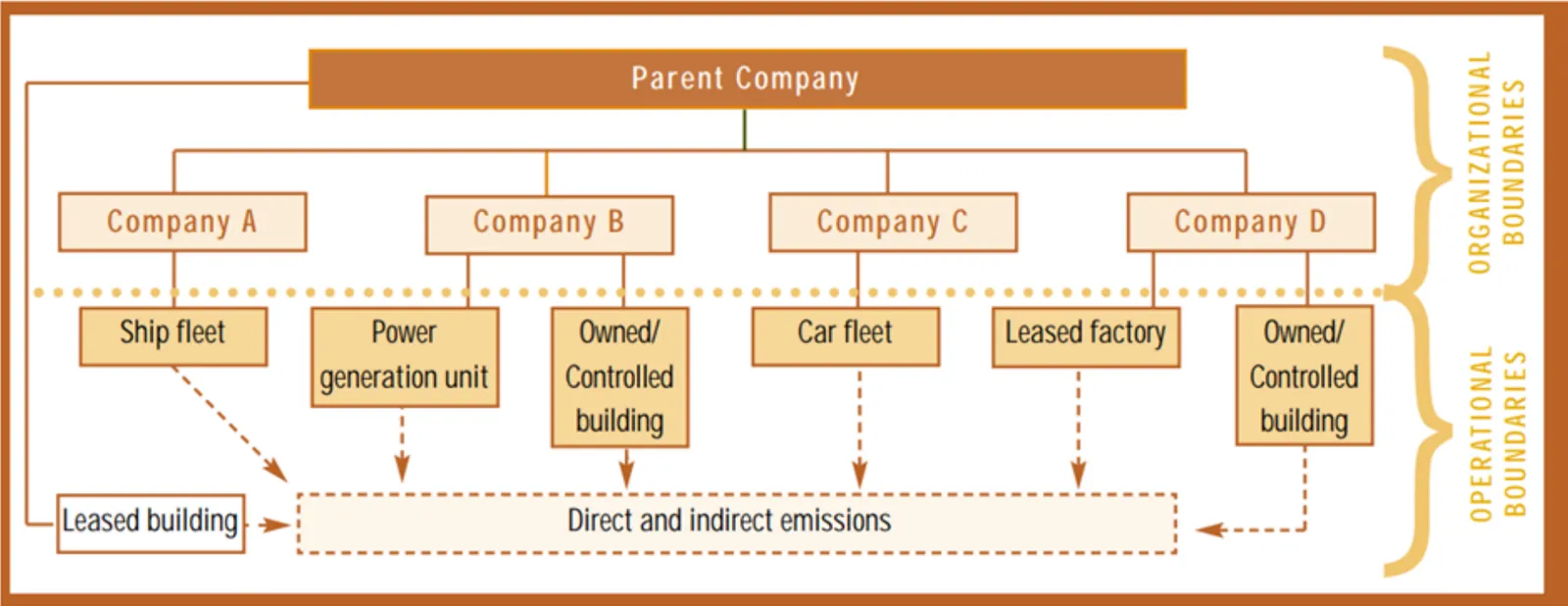
When reporting on GHG emissions, it is important to set the appropriate boundaries to ensure that the GHG inventory is correct and to avoid double counting emissions. The GHG Protocol defines two main types of boundaries – organisational or operational boundaries.
(a) Organisational boundary: the GHG Protocol defines it as the boundaries that determine the operations owned or controlled by the reporting undertaking depending on the consolidation approach taken. There are two approaches to consolidation of emissions – the equity or control approach. The undertaking will choose the approach that reflects its circumstances.
(b) The equity share approach relates to accounting for GHG emissions from operations according to its shares of equity in the operation.
(c) When using the control approach, the undertaking accounts for GHG emissions from operations over which it has either financial or operational control. Companies will use either the operational control or financial control criteria when using this approach to consolidate and capture its emissions in the report.
i. Financial control means that the undertaking has financial control over the operation if the former has the ability to direct the financial and operating policies of the latter with a view to gaining economic benefits from its activities.
ii. Operational control means that an undertaking has operational control over an operation if the former or one of its subsidiaries has full authority to introduce and implement its operating policies at the operation.
(d) Operational boundary: the GHG Protocol defines it as the boundaries that determine the direct and indirect emissions associated with operations owned or controlled by the reporting company. This assessment offers an undertaking the ability to establish which operations and sources cause direct (Scope 1) and indirect emissions (Scope 2 and Scope 3) and to decide which indirect emissions to include resulting from its operations.
(e) Boundary considerations need to follow the principles detailed above (consistency over time, transparency in documenting them and completeness) and are visualised in the image below [7].
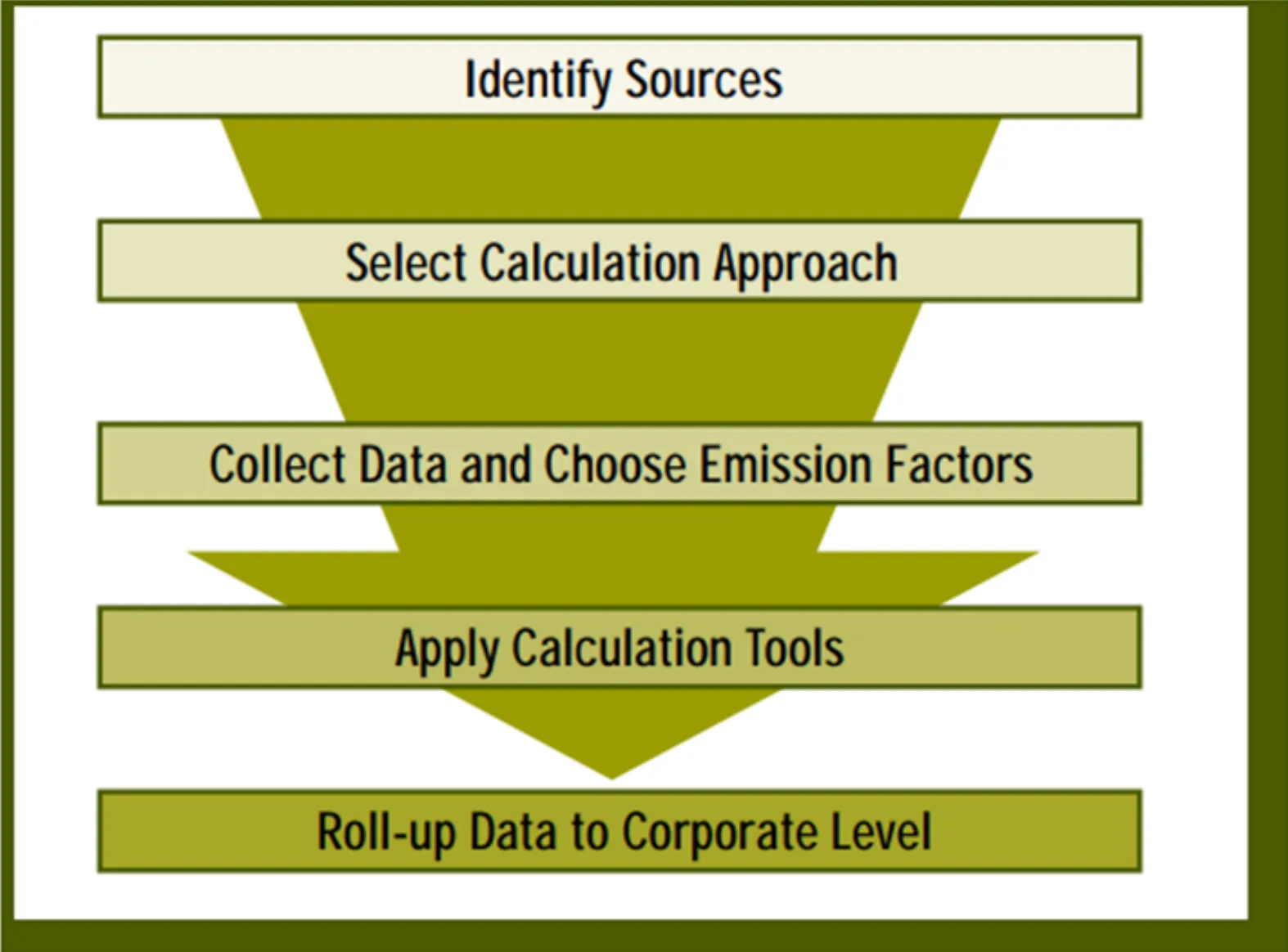
- The GHG Protocol also introduces guidance as well as steps to follow to identify, calculate and track GHG emissions as visualised in the image below [8].
- Different tools have been developed by private and public initiatives to help undertakings in developing their GHG emissions inventory and facilitating challenges related to its preparation:
(a) calculation tools and guidance by the GHG Protocol: https://ghgprotocol.org/calculationtools-and-guidance
(b) SME Climate hub: https://smeclimatehub.org/start-measuring/
(c) Business Carbon Calculator by Normative: https://businesscarboncalculator.normative.io/en/ (
d) Carbon Trust SME Carbon Footprint Calculator: https://www.carbontrust.com/our-work-andimpact/guides-reports-and-tools/sme-carbon-footprint-calculator
(e) UK Business Climate hub: https://businessclimatehub.uk/carbon-footprint-calculators/
Scope 1 and location-based Scope 2 emissions guidance
-
Typical Scope 1 emissions include CO2 (as well as CH4 and N2O) emissions associated with fuel combustion (for example in boilers, furnaces, vehicles, etc.) and fugitive emissions from air conditioning and industrial processes.
-
Location-based Scope 2 includes emissions from electricity, heat, steam and cooling purchased or acquired and consumed by the reporting company. It reflects the average emissions intensity of grids on which the energy consumption occurs and uses mostly grid-average emission factor data. Typical sources of Scope 2 emissions relate to any equipment that consumes electricity (electrical engines, lights, buildings, etc.), heat (heating in industrial processes, buildings, etc.), steam (industrial processes) and cooling (industrial processes, buildings, etc.).
-
Evaluating GHG emissions can be done in several ways, including by the calculation approach, measurement, or a combination of measurement and calculations. One common approach is based on calculating with use of emission factors (EF) – which may incorporate the global warming potential (GWP) of the GHG. Direct measurement using sensors (flow and concentration) can also be applied. The table below summarises the most common methods
| GHG evaluation method | Details | Necessary data |
|---|---|---|
| Measuring | Multiplying the quantities of gas directly measured by their respective global warming potential. | Direct quantity of gas emitted obtained from gas measurement (flow, concentration, volume) Global warming potential (GWP) of the gases |
| Calculating | Multiplying the activity data by the emission factor (EF) that integrates the global warming potential (GWP) | Activity data Emission factors (EF) |
- The table above introduces the following terms:
(a) activity data, which typically corresponds to the quantity of fuel consumed. It may be expressed in energy units (e.g. MWh), volume (e.g. m³ or l) or mass (e.g. tonnes or kg.). These can be accessed by the undertaking by reviewing fuel purchase receipts or utility bills:
(b) global warming potential, which quantifies the impact of the given GHG on the climate compared to an equivalent unit of carbon dioxide; and
(c) emission factors (FE), quantifying how much GHG is emitted per unit of activity. The emission factors frequently take into account the GWP of the GHG, in which case the undertaking does not need to consider the latter.
- The table below summarises non-exhaustive sources where both emission factors (FE) and global warming potential (GWP) can be easily accessed by undertakings. Undertakings may also refer to authoritative national sources that may be more relevant to their circumstances.
| Emission factors (FE) | ADEME – Base Empreinte® IPCC – Emissions Factor Database IPCC – Guidelines for National Greenhouse Gas Inventories Association of Issuing Bodies (AIB) – Residual Mix Grid Emission Factors [JRC – Historical GHG emissions factor for electricity consumption](http://IPCC – Guidelines for National Greenhouse Gas Inventories) Life-cycle electricity production emission factors USEPA GHG emission factors Hub Emission Factors and reference values published by the Government of Canada IEA’s Annual GHG emission factors for World countries from electricity and heat generation (2022 data set, paid data set) |
|---|---|
| Global warming potential (GWP) | IPCC – Global Warming Potential |
- The undertakings can also find more guidance and tools on how to act and report on their GHG emissions and climate impacts by visiting https://smeclimatehub.org/.
Example of Scope 1 emission calculation
-
Company A burns Nr. 4 fuel oil in an industrial boiler. For its financial accounting, it keeps track of its costs, and for GHG accounting purposes, it keeps track of volumes (m³) as reflected in their fuel receipts. From the receipts, it determines the annual volumes of fuel oil bought, and it keeps track as well of the fuel oil inventory on the first calendar day of the year. In 2023 it purchased 100 m³ of fuel oil. Based on its records, on 1 January 2023 it had 2.5 m³ in its reservoirs, and on 1 January 2024 it had 1 m³. Thus, it determines (through purchase and measurement of inventory) that during 2023 it consumed 101.5 m³ of fuel oil.
-
Using the IPCC list of emissions factors (Table 2.3, page 2.18), it estimates its emission factor to be a fifty-fifty blend of diesel oil and residual oil as 75.75 t CO2/TJ, and by using published statistics on energy, determines that its net calorific value of the fuel is 0.03921 TJ/m3 . Given that the CO2 GWP equals one, its CO2 emission for this specific Scope 1 source is:
101.5 m3 0.03921 TJ/m3 75.75 t CO2/TJ * 1 = 301.5 t CO2
106. For the purpose of completeness in this example, the CH4 and N2O emissions are also calculated. Checking the IPCC list of emission factors shows that these are, respectively, 3 kg of CH4/TJ and 0.6 kg of N2O/TJ, the emissions thus being:
*CH4 emissions = 101.5 m3 0.03921 TJ/m3 3 kg CO2/TJ ** 29.8 = 0.36 tCO2e
N2O emissions = 101.5 m3 0.03921 TJ/m3 0.6 kg CO2/TJ * 273 = 0.65 tCO2e
- As mentioned, CH4 and N2O emissions add around 1 tCO2e to the CO2 value of 301.5 tCO2, which amounts to about 0.3% of the total. This could be considered well within an acceptable reporting error and so could not have been calculated and reported. Global Warming Potentials for CH4 and N2O are derived from the IPCC’s Sixth Assessment Report, Chapter 7SM [9] .
Example of Scope 2 emission calculation
- Company A occupies an office building of 2000 m2 in Paris, where it pays the electricity consumed for the central heating and cooling, lighting, computers and other electric equipment such as appliances. With its utility bills, it has estimated that the building consumed 282 MWh of electricity in 2022. By using the emission factor provided by nowtricity.com for France in 2022, it has estimated its Scope 2 emissions for its building electricity consumption to be
𝐸𝑚𝑖𝑠𝑠𝑖𝑜𝑛𝑠𝐺𝐻𝐺 = 282 000 [𝑘𝑊ℎ] ∗ 73 [ 𝑔 𝐶𝑂2𝑒𝑞 / 𝑘𝑊ℎ ] = 20.6 t CO22𝑒𝑞
- Undertakings may also want to provide their market-based Scope 2 figures. Emission factors for market-based Scope 2 emissions reflect the contractual arrangements of the undertaking with its energy suppliers. Market-based emission factors can be provided by their electricity or heat suppliers as well as supported by their own purchase of Energy Attribute Certificates or Power Purchase Agreements (PPAs) or the use of residual-mix emission factors.
🗂️ VSME Comprehensive Module Guidance – Environmental Metrics, page 44-44
Consideration when reporting on GHG emissions under B3 (Basic Module)
-
When determining whether disclosure of Scope 3 is appropriate following paragraph 50, the undertaking may screen its total Scope 3 GHG emissions based on the 15 Scope 3 categories identified by the GHG Protocol using appropriate estimates and report by incorporating this information by reference. This allows for the identification and disclosure of its significant Scope 3 categories based on the magnitude of their estimated GHG emissions and other criteria provided by the GHG Protocol Corporate Value Chain (Scope 3) Accounting and Reporting Standard (Version 2011, p. 61 and 65-68) or EN ISO 14064-1:2018 Annex H.3.2, such as financial spend, influence, related transition risks and opportunities or stakeholder views.
-
SMEs operating with manufacturing, agrifood, real estate construction and packaging processes are likely to have significant Scope 3 categories (CDP, 2024), which may be considered relevant for reporting in the undertaking’s sector.
[5] In a future online tool version of the VSME Standard, this will be automatically calculated.
[7] Greenhouse Gas Protocol Corporate Standard: https://ghgprotocol.org/sites/default/files/standards/ghg-protocolrevised.pdf
[8] Greenhouse Gas Protocol Corporate Standard: https://ghgprotocol.org/sites/default/files/standards/ghg-protocolrevised.pdf
[9] Smith, C., Z.R.J. Nicholls, K. Armour, W. Collins, P. Forster, M. Meinshausen, M.D. Palmer, and M. Watanabe, 2021: The Earth’s Energy Budget, Climate Feedbacks, and Climate Sensitivity Supplementary Material. In Climate Change 2021: The Physical Science Basis. Contribution of Working Group I to the Sixth Assessment Report of the Intergovernmental Panel on Climate Change (Masson-Delmotte, V., P. Zhai, A. Pirani, S.L. Connors, C. Péan, S. Berger, N. Caud, Y. Chen, L. Goldfarb, M.I. Gomis, M. Huang, K. Leitzell, E. Lonnoy, J.B.R. Matthews, T.K. Maycock, T. Waterfield, O. Yelekçi, R. Yu, and B. Zhou (eds.)). Available on https://www.ipcc.ch/.