S1-8 – Collective bargaining coverage and social dialogue
🗂️ ESRS S1 Own workforce, page 11-12
-
The undertaking shall disclose information on the extent to which the working conditions and terms of employment of its employees are determined or influenced by collective bargaining agreements and on the extent to which its employees are represented in social dialogue in the European Economic Area (EEA) at the establishment and European level.
-
The objective of this Disclosure Requirement is to enable an understanding of the coverage of collective bargaining agreements and social dialogue for the undertaking’s own employees.
-
The undertaking shall disclose:
(a) the percentage of its total employees covered by collective bargaining agreements;
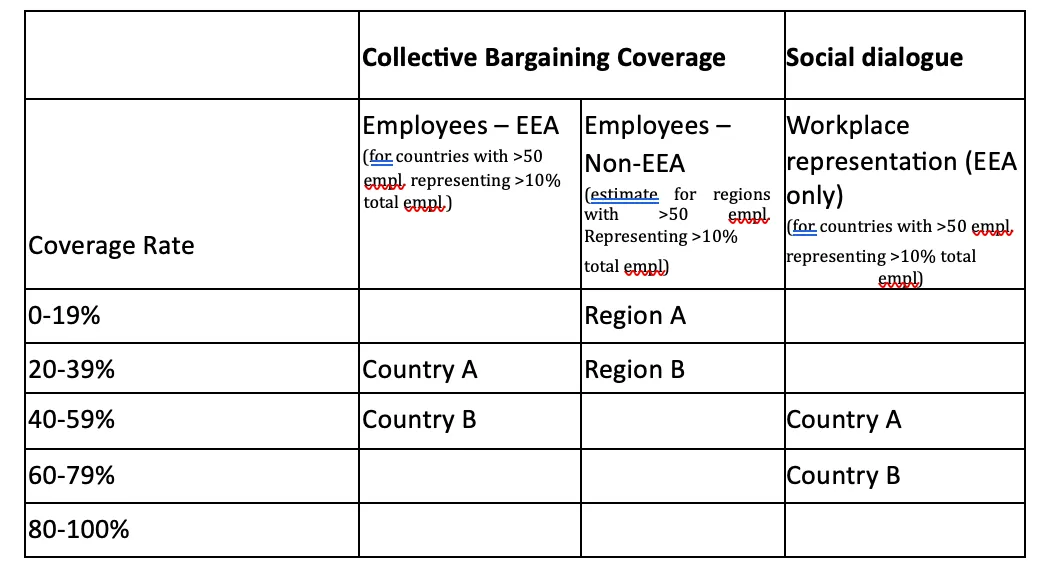
(b) in the EEA, whether it has one or more collective bargaining agreements and, if so, the overall percentage of its employees covered by such agreement(s) for each country in which it has significant employment, defined as at least 50 employees by head count representing at least 10% of its total number of employees; and
(c) outside the EEA, the percentage of its own employees covered by collective bargaining agreements by region.
-
For employees not covered by collective bargaining agreements, the undertaking may disclose whether it determines their working conditions and terms of employment based on collective bargaining agreements that cover its other employees or based on collective bargaining agreements from other undertakings.
-
The undertaking may disclose the extent to which the working conditions and terms of employment of non-employees in its own workforce are determined or influenced by collective bargaining agreements, including an estimate of the coverage rate.
-
The undertaking shall disclose the following information in relation to social dialogue:
(a) the global percentage of employees covered by workers’ representatives, reported at the country level for each EEA country in which the undertaking has significant employment; and
the existence of any agreement with its employees for representation by a European Works Council (EWC), a Societas Europaea (SE) Works Council, or a Societas Cooperativa Europaea (SCE) Works Council.
Application Requirements
Section titled “Application Requirements”AR 66. The percentage of employees covered by collective bargaining agreements is calculated using the following formula:

AR 67. The employees in the undertaking’s own workforce covered by collective bargaining agreements are those individuals to whom the undertaking is obliged to apply the agreement. This means that if none of the employees are covered by a collective bargaining agreement, the percentage reported is zero. An employee in the undertaking’s own workforce covered by more than one collective bargaining agreement only needs to be counted once.
AR 68. This requirement is not aimed at obtaining the percentage of employees represented by a works council or belonging to trade unions, which can be different. The percentage of employees covered by collective bargaining agreements can be higher than the percentage of unionised employees when the collective bargaining agreements apply to both union and non-union members. Alternatively, the percentage of employees covered by collective bargaining agreements can be lower than the percentage of unionised employees. This may be the case when there are no collective bargaining agreements available or when the collective bargaining agreements do not cover all unionised employees.
Social Dialogue
AR 69. For calculating the information required by paragraph 63(a), the undertaking shall identify in which European Economic Area (EEA) countries it has significant employment (i.e., at least 50 employees representing at least 10% of its total employees). For these countries it shall report the percentage of employees in that country which are employed in establishments in which employees are represented by workers’ representatives. Establishment is defined as any place of operations where the undertaking carries out a non-transitory economic activity with human means and goods. Examples include: a factory, a branch of a retail chain, or an undertaking’s headquarters. For countries in which there is only one establishment the percentage reported shall be either 100% or 0%.

Table 1: Reporting template for collective bargaining coverage and social dialogue